
📊 Full opportunity report: Quiet GPUs for Local AI: Acoustic and Thermal Roundup on ThorstenMeyerAI.com — validation score, market gap, and execution plan.
TL;DR
This article reviews the quietest GPUs for local AI in 2026, highlighting models that balance performance, heat, and noise. Power management and cooling are key to achieving quiet operation.
In 2026, the top GPUs for local AI are those that combine high performance with low noise and thermal output, thanks to optimized cooling and power management strategies. The RTX 5090 emerges as the best single-GPU choice when properly cooled and power-capped, offering high VRAM and inference speed while remaining quiet. This shift toward quieter, cooler GPUs addresses longstanding issues for users running AI models locally near their workstations.
The report evaluates GPUs across VRAM tiers, emphasizing that the key to quiet operation lies in undervolting and choosing partner cards with superior cooling. The RTX 5090, with 32GB of GDDR7, is identified as the top choice for demanding local AI setups, capable of running 70B models at Q4 quantization with minimal noise when power-capped and cooled properly. The RTX 4090 and used RTX 3090 continue as value options in the 24GB tier, offering reliable performance at lower costs.
For medium-sized models, the RTX 5080 and RTX 4060 Ti (16GB) offer efficient, low-power alternatives that produce less heat and noise, ideal for moderate workloads. The professional RTX PRO 6000 Blackwell with 96GB VRAM is highlighted for dense, high-end AI applications, though its noise profile depends heavily on cooling solutions. The article underscores that cooler, undervolted configurations can transform even high-power cards into near-silent operation, making high-performance local AI feasible in quieter environments.
Quiet GPUs
for local AI.
The GPU makes ~70% of your heat and most of your noise. But here’s the secret: the chip doesn’t decide how loud your card is — the cooler design and your power settings do. Match your VRAM tier in Part 2, then make it quiet.
Capping to 70–80% sheds a huge amount of heat for almost no inference loss — because inference is memory-bound. A capped 5090 is dramatically cooler & quieter than stock. Do this first.
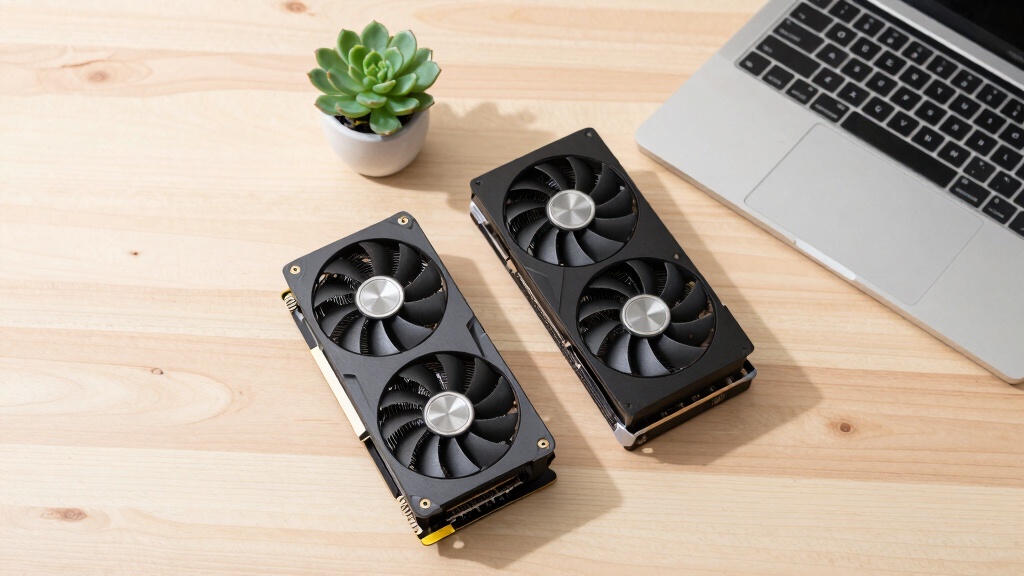
Within one GPU model, partner cards differ enormously. For a single card, a large triple-fan open-air with zero-RPM idle runs slow & quiet. For multi-GPU, the calculus flips →
With room to breathe, a large triple-fan open-air cooler spreads heat across a big fin stack and runs its fans slowly. The quietest choice — what most people should buy.
Impact of Cooler, Undervolted GPUs on Local AI Workstations
This review demonstrates that with proper cooling and power management, high-performance GPUs can operate quietly, making local AI deployment more practical and less disruptive. It shifts focus from raw speed to acoustic and thermal efficiency, benefiting users who need powerful yet silent AI rigs, especially in shared or office environments. The findings encourage users to prioritize cooling solutions and undervolting techniques to optimize existing hardware, expanding the feasibility of local AI at home or in small labs.
GEEKOM A9 Mega AI Workstation Desktop PC, Ryzen AI Max+ 395 for Local LLM
- Limited Supply of Ryzen AI Max+ 395: First to integrate this high-performance chip
- Exclusive 126 TOPS AI Performance: Unlocks advanced local large language models
- 3-Year Warranty & 24/7 Reliability: Industrial-grade build with extended warranty
As an affiliate, we earn on qualifying purchases.
As an affiliate, we earn on qualifying purchases.
2026 GPU Landscape and Cooling Strategies
Historically, GPUs for local AI have been hampered by noise and heat, especially under sustained inference loads. Recent advances in GPU architecture, cooling technology, and undervolting techniques have begun to change this landscape. The RTX 5090, released in early 2026, represents the latest high-end option, while mid-tier models like the RTX 5080 and 4060 Ti focus on efficiency. The importance of cooler design, power capping, and undervolting has become central to achieving quiet operation, with many manufacturers offering specialized variants for silent performance."Proper cooling and undervolting can turn even the hottest, loudest GPUs into near-silent workhorses, making local AI more accessible and less disruptive."
— Thorsten Meyer, AI hardware expert
Remaining Questions on Long-Term Quiet GPU Performance
It is not yet clear how these GPUs will perform over extended periods of continuous use, especially regarding thermal stability and fan wear. The effectiveness of undervolting and cooling strategies may vary by manufacturer and specific card model, and real-world noise levels depend heavily on cooling design and user configuration. Further testing is needed to confirm long-term reliability and noise profiles.Future Developments in Quiet GPU Design and AI Workstations
Upcoming GPU models are expected to further improve thermal and acoustic performance through advanced cooling solutions and more efficient architectures. Manufacturers may release dedicated silent variants, and software tools for undervolting and fan control will likely become more user-friendly. Continued research into passive cooling and innovative heatsink designs could make high-performance, silent AI rigs more accessible for a broader user base.Key Questions
Can I make any high-power GPU run quietly?
Yes, by undervolting the GPU and using a high-quality cooling solution, most high-power GPUs can be made to operate with significantly reduced noise levels.
Is the RTX 5090 suitable for a quiet home AI setup?
With proper cooling and power capping, the RTX 5090 can be configured for quiet operation, making it suitable for a home or office environment.
How much does cooling impact GPU noise levels?
Cooling design is a critical factor; larger, well-ventilated heatsinks and fan configurations that support zero-RPM modes greatly reduce noise, regardless of GPU power.
Will future GPUs be quieter by default?
It is likely, as manufacturers continue to develop more efficient cooling solutions and optimize power consumption, leading to quieter operation without sacrificing performance.
Source: ThorstenMeyerAI.com