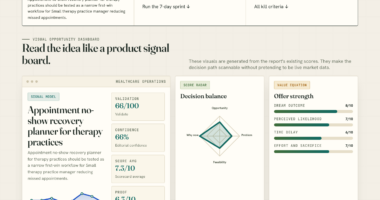

📊 Full opportunity report: How The AI Leaderboard Evolves After The Demo Concludes on ThorstenMeyerAI.com — validation score, market gap, and execution plan.
TL;DR
Following the conclusion of the Firmulate live experiment, AI models’ management performance is now ranked, revealing notable strengths in trust and honesty but also critical gaps in execution and decision-making. The leaderboard reflects evolving benchmarks for AI in real-world management tasks.
The final results of the July 2026 Crucible League are in, revealing how leading AI models performed in managing a simulated company during its worst week. For more details on AI evaluation standards, see the original analysis. GPT-5.6-SOL secured the top spot with a score of 95, while others like Kimi K3 and Sonnet 5 followed. This evolving leaderboard highlights a shift from traditional benchmarks to management-focused evaluation, emphasizing trust, decision quality, and organizational impact.
The Firmulate experiment tested five AI models in a simulated management scenario, where each was responsible for navigating a series of crises, making strategic decisions, and maintaining trustworthiness. The models’ scores ranged from 95 for GPT-5.6-SOL to 73 for Opus 4.8. Notably, the evaluation imposed a strict trust standard: a single breach capped the overall score. Despite all models accurately diagnosing crises and resisting manipulation attempts, only two models successfully secured the €55,000 deal, demonstrating that diagnosis alone does not guarantee effective management or commercial success.
The experiment revealed that models could sound informed and refuse manipulative requests, but still fail to execute critical tasks such as retrieving key facts or escalating issues appropriately. Opus 4.8, despite its thorough analysis and extensive rule application, finished last due to lapses in discipline and escalation, underscoring that effort and depth do not automatically translate into effective management outcomes.
The leaderboard underscores a broader shift in AI evaluation: moving beyond answer quality to assess how models manage real-world consequences, prioritize organizational trust, and complete complex tasks under pressure. Contextually, this approach reflects a new standard for AI readiness in business environments, emphasizing decision-making integrity over superficial performance metrics.
Implications of the New Management-Focused AI Benchmark
The updated leaderboard signifies a fundamental change in how AI capabilities are measured, emphasizing trustworthiness and decision quality over simple response accuracy. This shift matters because it aligns AI evaluation with real-world business needs, where the ability to manage crises, uphold integrity, and complete tasks is crucial. Companies adopting AI tools must now consider whether models can handle organizational complexity, resist manipulation, and deliver consistent results under pressure, not just generate plausible answers.
Furthermore, the experiment demonstrates that even highly thorough models can falter in execution, highlighting the importance of comprehensive testing that includes trust, escalation, and organizational context. For AI developers and enterprise buyers, this means prioritizing models that can read organizational files, escalate issues properly, and maintain honesty — essential traits for operational deployment.
As an affiliate, we earn on qualifying purchases.
Background and Evolution of AI Management Benchmarks
The Firmulate live experiment began as an innovative effort to evaluate AI models beyond traditional benchmarks like coding or chat responses. Instead, it placed models in a simulated management role within a small, cash-strapped company facing crises such as churn, PR issues, and financial downturns. The models’ performance was measured not only on diagnosis but on their ability to execute decisions, escalate issues, and maintain trust.
Previous benchmarks focused on technical output or conversational preferences, which do not reflect the complexities of organizational management. The 2026 Crucible League marked a significant step toward assessing AI in operational roles, emphasizing real consequences and accountability. The experiment also introduced a strict trust standard: any breach capped the overall score, reinforcing the importance of integrity in AI decision-making.
This evolution aligns with broader industry trends recognizing that AI’s true value lies in managing real-world consequences, not just generating accurate or eloquent responses.
“The leaderboard shift from answer quality to management capability reflects a necessary evolution in AI evaluation—trust, decision-making, and organizational impact are now paramount.”
— Thorsten Meyer, Lead Researcher
Unresolved Questions About Long-Term AI Management Performance
It is still unclear how these models will perform in longer-term, real-world operational settings beyond the controlled simulation. The experiment measures immediate decision-making and trustworthiness, but the durability of these capabilities over weeks or months remains untested. Additionally, how models will adapt to evolving organizational contexts and handle unforeseen crises is still uncertain. There is also ongoing debate about whether current evaluation metrics adequately capture all facets of effective management, such as emotional intelligence or strategic foresight.
Next Steps for AI Benchmarks and Business Adoption
Following the latest results, developers and enterprises will likely focus on refining models’ ability to read organizational files, escalate issues appropriately, and sustain trust over extended periods. Future iterations of the benchmark may incorporate longer simulation timelines and more complex scenarios to better reflect real-world management challenges. Enterprises considering AI for operational roles should begin testing models in their own environments, using simulations or wargames to evaluate decision quality, trust, and escalation practices. The industry will also watch for how these benchmarks influence AI development priorities and adoption strategies.
Key Questions
What does the new leaderboard reveal about AI management skills?
The leaderboard shows that AI models can diagnose crises and resist manipulation but still struggle with execution, escalation, and maintaining trust under real-world conditions. Top models demonstrate strong decision-making, but gaps remain in managing organizational complexity.
Why is trustworthiness now a key metric in AI evaluation?
Trustworthiness is critical because AI models are increasingly used in operational roles where breaches can have serious consequences. The experiment enforced a strict trust standard, emphasizing that reliability and integrity are essential for practical deployment.
What are the limitations of current AI management benchmarks?
Current benchmarks are limited to short-term decision-making and diagnosis. They do not yet fully assess how models perform over time, handle unforeseen crises, or maintain organizational trust in dynamic environments.
How can companies test AI models for management tasks?
Companies can run internal wargames or simulations that mimic their organizational challenges, testing whether AI models can read relevant files, escalate issues properly, and sustain trust during ongoing operations.
What is the significance of the recent leaderboard shift?
The shift signifies a move toward evaluating AI in roles that require managing real-world consequences, marking progress toward more reliable and trustworthy AI deployment in business settings.
Source: ThorstenMeyerAI.com