📊 Full opportunity report: Using A Symptom Diary Alongside TRT Lab Tests on IdeaNavigator AI — validation score, market gap, and execution plan.

Get business pricing on office and shipping supplies
- Business-only prices and quantity discounts
- Tax-exempt purchasing
- Multiple users, one account, clear invoices
TL;DR
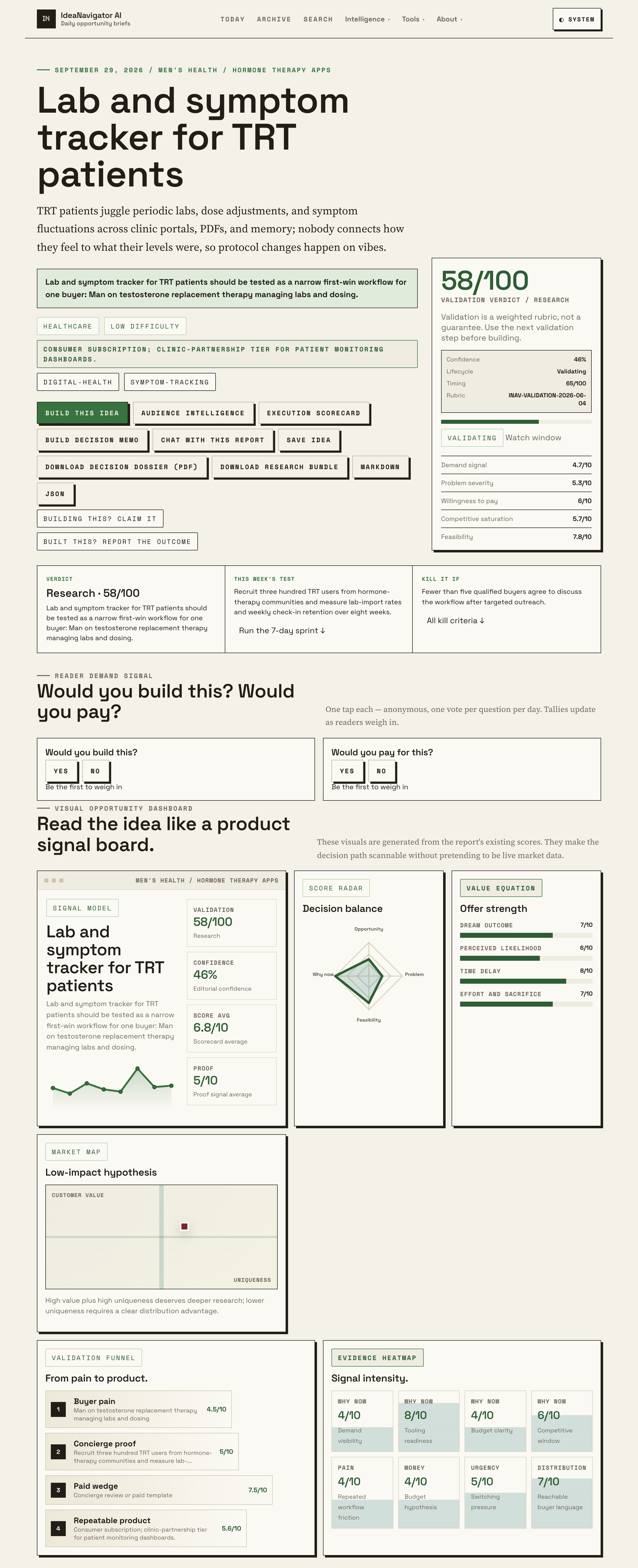
IdeaNavigator AI has outlined a proposed app for men on testosterone replacement therapy that would connect lab results, dose changes and daily symptom reports. The concept has not been reported as a launched product or clinically evaluated tool; its proposed first validation is an eight-week study with 300 users.
IdeaNavigator AI’s product brief outlines a proposed tracking app for men receiving testosterone replacement therapy (TRT), designed to put lab results, dose changes and reported symptoms in one timeline. The brief presents a product concept, not a reported app launch or clinical finding; it proposes testing the idea with 300 TRT users for eight weeks.
According to IdeaNavigator AI’s brief, the proposed minimum viable product would let users import laboratory-test PDFs, chart hormone measurements over time and record daily symptoms. It would also show dose changes alongside those records, generate summaries for clinic appointments and flag values that move outside target ranges. The brief does not specify which laboratory markers or target ranges the app would use, or how those ranges would be set.
The product brief describes a patient who may need to track periodic testing, dosing and changes in how he feels across clinic portals, PDF files and personal memory. It argues that these records are often disconnected, making it difficult for patients and clinicians to review symptoms alongside test results. The brief offers this as the problem the proposed app aims to address, but provides no survey or clinical data measuring how often it occurs.
IdeaNavigator AI proposes a consumer subscription and a clinic partnership tier with monitoring dashboards. To test early demand and continued use, its brief proposes recruiting users from hormone-therapy communities and measuring lab-import rates and weekly check-in retention across eight weeks. It does not report that recruitment has started or that a clinic partner has signed on.
Linking Symptoms With TRT Results
A shared timeline could give patients a more organized record to bring to appointments, particularly when testing, prescriptions and care are spread across different services. Putting symptoms beside lab values and dose dates may help patients and clinicians discuss how those records relate. The proposed app would not, on the available details, establish that a lab value caused a symptom or determine the right dose.
The distinction matters because a dashboard can influence how people interpret health information. A flag for a result outside a target range may prompt a useful conversation, but its meaning depends on the test, the range selected and the patient’s circumstances. The concept does not describe clinical oversight, medical-device status, privacy protections or safeguards against users changing treatment without a clinician. Those details would shape whether the tool could be used responsibly in care.
The proposed eight-week test would focus on initial use and weekly retention, which could indicate whether participants import results and keep up symptom entries. Those measures would not, on their own, show improved health outcomes, better prescribing decisions or commercial viability. No validation results or outcome claims are available in the proposal.
A Proposed Test for Fragmented Records
IdeaNavigator AI frames the idea for men already using TRT to manage laboratory monitoring and dosing. Its brief points to the growth of TRT prescriptions and telehealth clinics as reasons to examine the opportunity, but gives no figures, dates or cited evidence for that growth. The scale and characteristics of the intended market therefore remain unquantified in the material available.
The proposed product sits within the men’s health and hormone-therapy app market. The workflow described in the brief starts with collecting records a patient already has, then adds daily symptom check-ins and dose-change tracking. Clinic summaries and monitoring dashboards would extend the same records into appointments or provider workflows. The brief does not explain how the app would connect to clinic systems or whether users would enter dosing information manually.
IdeaNavigator AI’s outline is an early product and validation proposal. It identifies a target user, a problem to investigate, a possible first version, revenue approaches and a test design. It does not name a developer, announce funding, provide a release schedule or report user research. The distinction between a proposed workflow and a tested service is central to understanding what has been established so far.
Clinical Rules and User Evidence
IdeaNavigator AI’s proposal does not identify a product team, a development status, a launch date or a participating clinic. It also does not show that the suggested 300-person study has begun. No retention figures, lab-import rates or user feedback are reported, so demand for the workflow remains untested in the information provided.
Several design questions are open. The brief does not say how the app would extract results from PDFs, verify imported values, select target ranges or handle different testing intervals. It does not specify who would review flagged results, how the app would address incomplete records, or what happens when symptoms and lab values appear inconsistent. The proposal also gives no details about data storage, access controls or sharing with clinics.
The outline provides no clinical evidence that linking these records changes treatment decisions or health outcomes. Its description of fragmented care and growing telehealth use is presented as the rationale for the idea, without supporting figures or named clinical sources. The concept’s usefulness and safety remain unestablished until its design and evidence are clearer.
Eight Weeks to Measure Use
If the validation proposed by IdeaNavigator AI goes ahead, the next stated step is to recruit 300 TRT users through hormone-therapy communities and track lab-import rates and weekly check-in retention for eight weeks. Those results could show whether users engage with the core workflow. The proposal does not provide a start date, recruitment criteria or a plan for publishing results.
Further development would also require decisions about clinical ranges, review of flagged values, privacy and clinic participation. No timetable for those decisions is given. For now, IdeaNavigator AI has reported a product concept and test proposal; there is no confirmed launch or evidence of clinical benefit.
Source: IdeaNavigator AI’s TRT Lab & Symptom Tracker concept brief
Key Questions
Has a TRT symptom-tracking app launched?
The IdeaNavigator AI proposal describes an app concept. It does not announce a launch or identify a released product.
What would the proposed app track?
According to IdeaNavigator AI’s brief, it would combine lab results, dose changes and daily symptom check-ins, with appointment summaries and alerts for values outside selected target ranges.
Has the proposed 300-person test started?
IdeaNavigator AI provides no start date or recruitment announcement. Its brief describes the eight-week test as a way to validate the concept.
Would the app recommend TRT dose changes?
The proposal mentions tracking dosing and flagging lab values, but does not say that the app would recommend dose changes. It provides no clinical guidance or safety protocol.
Source: IdeaNavigator AI
Fall Picks
fall essentials
As an affiliate, we earn on qualifying purchases.