
🔍 Read the full analysis: What Should You Look For In AI Workflow Automation Software? on ThorstenMeyerAI.com

Get business pricing on office and shipping supplies
- Business-only prices and quantity discounts
- Tax-exempt purchasing
- Multiple users, one account, clear invoices
TL;DR
The supplied guide compares 14 resources for choosing AI workflow automation, from no-code approaches to developer and enterprise options. It recommends matching a choice to a team’s skills and operational needs, while noting that cost, integrations, security and ongoing maintenance also matter.
The guide identifies The No-Code AI Automation Playbook as its best overall choice for business users seeking to start without programming. It presents the resource as a bridge between platforms including Zapier, Make and n8n. For developers seeking more control over custom agents, it points to n8n AI Automation and its Python integration.
Its recommendations span distinct user groups rather than treating automation as a single product category, a topic covered in these AI workflow automation guides. The guide names Agentic Coding with Claude Code and Agentic AI for DevOps as resources focused on developer-led agents, while AI-Powered Automation for Small Business emphasizes beginning with lower-complexity tasks. For organizations already using Microsoft products, it describes Microsoft Power Automate as a default option to consider.
ThorstenMeyerAI.com says it assessed the resources for practical applicability and technical accessibility, including whether instructions can lead to a working workflow. The supplied material does not provide a complete list of all 14 options, individual scores, or independent testing results, so its rankings should be understood as the guide’s editorial assessment.
The 14 picks
- 1
 Agentic AI for DevOps Engineers: Building Autonomous CI/CD, Infrastructure, a…View on Amazon →
- 2
 Workflow Automation with Microsoft Power AutomateView on Amazon →
- 3
 Claude AI for Smart Automation: No-Code Strategies to Build Intelligent Workf…View on Amazon →
- 4
 The No-BS Guide to AI Agents & Automation: Build AI Workflows, Automate Your…View on Amazon →
- 5
 AI Agents: From Theory to Operations — A Practical Guide to Business Automati…View on Amazon →
- 6
 50 AI Workflows for Engineers: From Debugging to System Design, Code Review &…View on Amazon →
- 7
 AI-Powered Automation and Workflows for Small Business OwnersView on Amazon →
- 8
 Practical Autonomous Workflow Automation: Build AI Agents and Automate Real-W…View on Amazon →
- 9
 Hands-On AI Workflow Automation: A Beginner-Friendly Roadmap to Eliminating R…View on Amazon →
- 10
 The No-Code AI Automation Playbook: Build Practical AI Workflows with Zapier,…View on Amazon →
- 11
 AI for Everyday Automation: 7 AI Workflows to Save Hours at Work Every WeekView on Amazon →
- 12
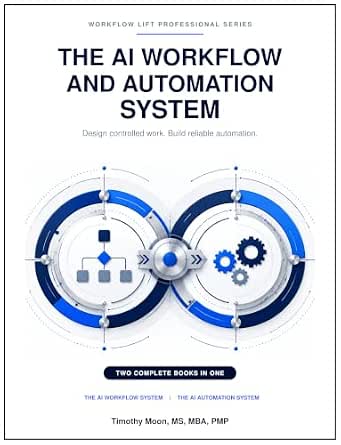 AI Workflow and Automation System – Workflow Lift Professional SeriesView on Amazon →
- 13
 n8n AI Automation: Build Smarter Workflows, Agents, and Intelligent Systems w…View on Amazon →
- 14
 Agentic Coding with Claude Code (5-in-1): A Practical Developer’s Handbook fo…View on Amazon →
Matching Automation to Team Needs
The choice can shape how quickly a workflow is launched, how much engineering support it needs and whether it remains manageable as usage grows. A simple visual builder may suit a team automating routine tasks, but complex branching and custom logic can make it harder to maintain. Code-first frameworks offer more control, but require people with the skills to build and support them.
The guide also draws attention to less visible costs. Buyers should check whether a platform supports the applications and APIs they rely on, how its pricing changes with volume, and what security controls apply to data moving between services. A workflow that works in a small trial may create expense or operational risk at scale.
Popular right now

De'Longhi Dinamica Plus Fully Automatic Espresso Machine

eufy C28 Robot Vacuum Cleaner and Mop for Pet Hair, 15,000 Pa

Ninja Foodi 10-Qt DualZone Air Fryer, 6-in-1, Black (DZ302)
As an affiliate, we earn on qualifying purchases.
How the Guide Groups Options
The source organizes its recommendations by user profile: business owners seeking no-code tools, engineers building custom automations, and enterprises working across complex cloud environments. It says that a tool’s fit depends on both technical maturity and the intended operation, rather than on AI capabilities alone.
Its examples include Zapier and Make for accessible automation, n8n for users seeking more control, and Power Automate for Microsoft-centered organizations. These are recommendations from the guide, not a statement that one platform is best for every organization.
“The main tradeoff in this category is simplicity versus scalability.”
— ThorstenMeyerAI.com guide
Limits of the Published Comparison
The supplied source does not name every option in the 14-item selection, give publication or review dates, or disclose comparative test results. It also does not provide pricing comparisons, measured performance data or evidence that the named products meet specific security standards. Those details cannot be confirmed from the material provided.
Recommendations may also change as software features, integrations and pricing change. The guide advises checking API support, connector upkeep and data-handling terms, but the supplied excerpt does not report those checks for each option. Readers should verify current product documentation and requirements before adopting a platform.
Checks Before Choosing a Platform
Teams can start by mapping a specific workflow, identifying the applications and data it touches, and deciding who will build and maintain it. They should then test required integrations and error handling, review access controls and data retention, and estimate costs at higher task volumes—not only during an initial trial.
The next step is a limited pilot with clear measures, such as time saved, failure rates and staff effort. The source does not announce a follow-up comparison or a schedule for updates to the guide. Product capabilities and terms should be rechecked before a purchase or rollout.
Key Questions
What is the guide’s top recommendation for nontechnical users?
ThorstenMeyerAI.com names The No-Code AI Automation Playbook as its best overall choice for business users seeking to begin without coding. That is the guide’s assessment, not an independent performance finding.
Which option does the guide suggest for developers?
It points developers interested in custom agents toward n8n AI Automation, citing its Python integration. The source does not provide a detailed feature comparison with other developer tools.
What should a team check before adopting automation software?
Check technical fit, required application integrations, pricing at expected volume, security and data-handling terms, and who will maintain workflows when services or business rules change.
Does the source prove that one platform is best for all teams?
No. The guide frames recommendations around different user profiles and tradeoffs. Its supplied material does not include independent tests or data establishing a universal winner.
Source: ThorstenMeyerAI.com