
TL;DR

Get business pricing on office and shipping supplies
- Business-only prices and quantity discounts
- Tax-exempt purchasing
- Multiple users, one account, clear invoices
IdeaClyst creates a private, AI-powered war room for your startup ideas, offering structured debate, real research, and local control. It helps founders decide what to build with confidence, avoiding costly mistakes.
Imagine having a dedicated war room—your own command center—where every idea gets rigorously challenged, debated, and refined. Now, picture doing that on your laptop, with no cloud, no subscriptions, just your own files.
That’s what IdeaClyst offers: a local-first, AI-powered decision hub built for founders who want to stop guessing and start building with conviction. It’s not just about brainstorming; it’s about transforming fuzzy notions into validated plans you can defend confidently.
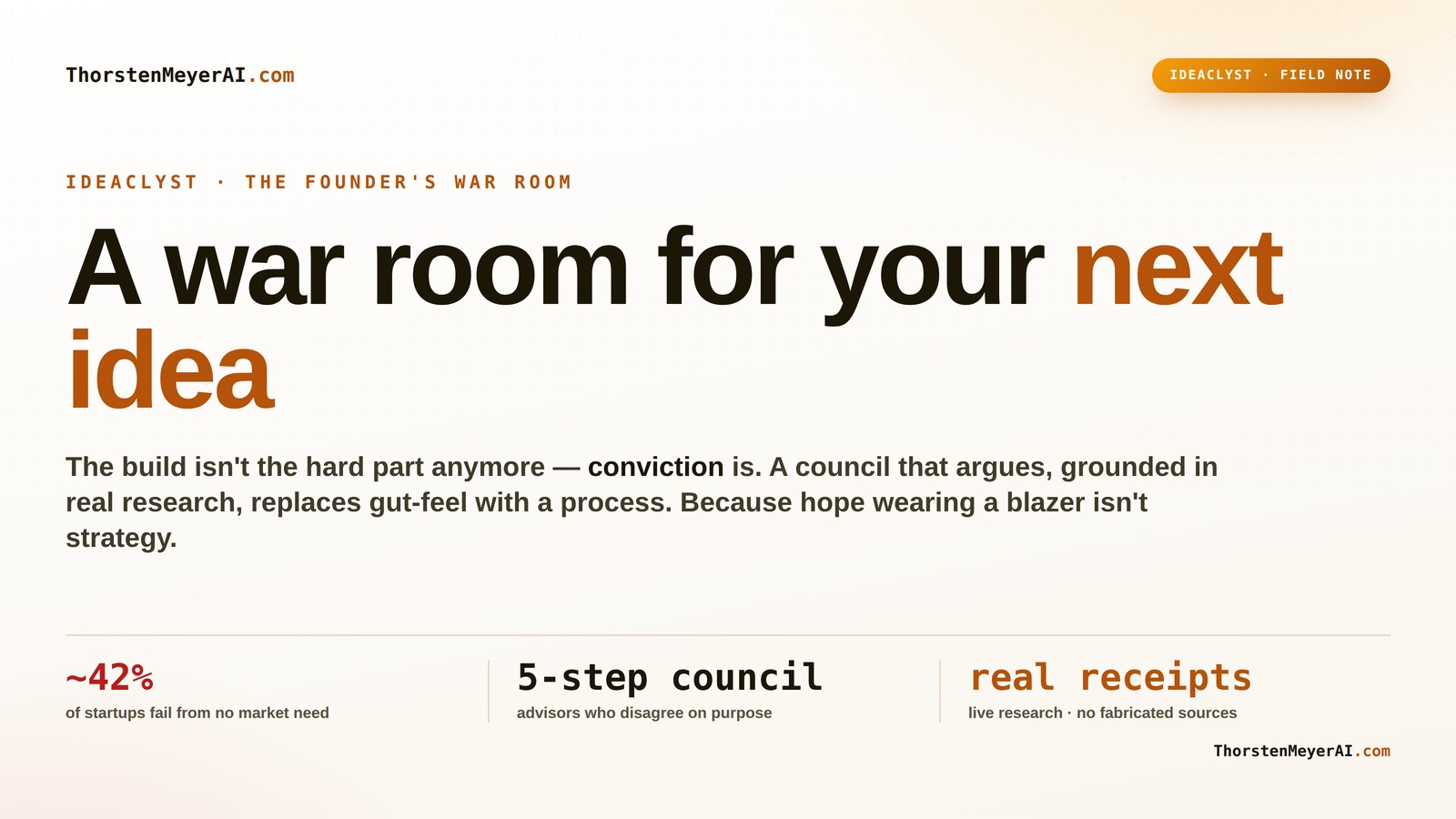
A war room for your next idea
The build isn’t the hard part anymore — conviction is. Knowing which idea deserves the next six months, and being able to defend it. Most founders answer with gut feel and optimistic math. That’s hope wearing a blazer. IdeaClyst replaces it with a process.
The most expensive decision is what to build
The single most valuable thing a tool can do is talk you out of the wrong six months. The numbers make the case better than any pitch.
Three tools in one — on your own machine
Strip away the framing and IdeaClyst is three things at once, all running locally with nothing leaving your laptop.
An AI council
Pressure-tests an idea you bring it — advisors who argue on purpose.
A discovery engine
Finds ideas you didn’t know to look for by hunting real demand signals.
A founder’s workspace
Carries winners from “interesting” all the way to “ready to build.”
Advisors who disagree on purpose
Not one confident, agreeable answer — a structured five-step deliberation where models play different roles and turn on their own work. The disagreement is the feature.
The five-step deliberation
A council that leads with the bad news surfaces the objections you’d otherwise find the expensive way, on month five.
Product strategy
Who’s it for, what’s the wedge, why now, what’s the business model.
Technical architecture
What would it actually take to build — and where’s the risk.
Critique pass
The council turns on its own work. Where’s the hand-waving? What kills this?
Second, independent critique
A different voice, a different angle — so blind spots don’t survive.
Final synthesis
Everything into one coherent founder packet: strategy, architecture, validation, plan.
When IdeaClyst cites a source, it actually fetched it
The hard departure from “ask an AI what it thinks of my startup.” It runs in a strict, real-data-only mode — if it can’t gather genuine evidence, it says so plainly rather than inventing a plausible paragraph.
Confidence with receipts
No fabricated statistics, no imaginary competitors, no made-up citations. The packet survives a skeptical co-founder or a sharp investor because the reasoning has receipts.
Market research first
Scouts the landscape before the council reasons about anything.
Competitor read
Real positioning, pricing signals, feature claims — differentiation vs. reality.
Validation with links
Not “talk to customers” — concrete signals & sources you can click.
From the blank page to build-ready
Evaluation is half the problem; the blank page is the other half. And a plan is worthless if it dies in a tab you never reopen.
Bring a space, not an idea
“AI for accountants,” “tools for indie game studios” — plus your goal and real capacity. It hunts demand signals across HN, Reddit, Product Hunt, GitHub, pricing pages.
- An honest market read — leads with the bad news when a space is hard
- An opportunity map — high pain, thin competition
- Ranked candidates — wedge, who pays, effort, risk, confidence
- each with KILL CRITERIA — when to walk away
A home and a forward path
Every promising idea gets carried forward, with every artifact in plain files on your disk.
- Validation tooling — sprint board, interview list, evidence browser
- Founder profile — a personal-fit lens; same discovery, different advice
- Build workspaces — funnel, personas, landing draft, version history
- “Build this idea” → a PRD + task queue, ready for a coding agent
Key Takeaways
- IdeaClyst turns your fuzzy startup ideas into defensible plans through structured AI debate and real research.
- Grounding ideas in live data prevents costly mistakes caused by overconfidence or outdated assumptions.
- A local-first setup keeps your ideas private and under your control, avoiding cloud dependencies.
- Regularly updating your war room with critiques and new research keeps your strategy sharp and adaptable.
- Structured templates and workflows help maintain momentum and clarity in your idea process.
local AI startup idea validation software
As an affiliate, we earn on qualifying purchases.
As an affiliate, we earn on qualifying purchases.
What Exactly Is a War Room, and Why Does It Matter?
A war room is a dedicated space—physical or digital—where teams come together to focus intensely on a project. It’s designed for visibility and real-time decision-making, making progress clear and keeping everyone aligned. It’s designed for visibility and real-time decision-making, making progress clear and keeping everyone aligned.
Think of a startup’s war room as the nerve center during a critical product launch. Everyone’s ideas, updates, and obstacles are visible on walls or screens, so the whole team’s effort is synchronized. Similarly, IdeaClyst functions as your digital war room, bringing structure and debate to your idea process without the clutter of traditional setups. Everyone’s ideas, updates, and obstacles are visible on walls or screens, so the whole team’s effort is synchronized. Similarly, IdeaClyst functions as your digital war room, bringing structure and debate to your idea process without the clutter of traditional setups.
According to sources like Design a Better Business, a war room boosts productivity by making work visible and encouraging collaboration — essential for fast-moving startups.
Having this shared space matters because it fosters transparency and accountability. When everyone can see progress and obstacles in real-time, it reduces misunderstandings and delays. For startups, this means faster pivots and more cohesive teamwork, ultimately increasing the chances of success.
Inside IdeaClyst: Your AI Council and Discovery Engine in Action
IdeaClyst’s secret sauce is its AI council. Instead of one AI giving you a single opinion, it stages a structured debate among multiple models, each playing a different role—product strategist, tech architect, critic, and skeptic.
For example, you feed it an idea: “A new AI-driven project management tool.” Instantly, the council evaluates market fit, technical feasibility, and potential risks, with each role pushing back or supporting your notion. The final report synthesizes these perspectives into a clear plan.
This structured disagreement mimics a real-world debate, helping you see flaws and opportunities you might ignore alone. The diversity of perspectives encourages deeper analysis, which is crucial because single opinions often overlook blind spots. The process pushes you to defend your assumptions and consider alternate viewpoints, leading to more robust ideas. Additionally, the discovery engine acts like an intelligent brainstorming partner, suggesting related ideas or pivots based on the council’s feedback, expanding your strategic options without extra effort.
By simulating a multi-faceted debate, IdeaClyst helps you surface hidden risks and opportunities early, enabling smarter decisions before costly investments. The combination of AI-driven critique and suggestion ultimately accelerates validation and reduces the risk of failure.
Why Grounding Ideas in Real Research Beats Model Vibes Every Time
Many founders ask AI tools for quick feedback. But AI’s confidence often masks a lack of real evidence. TheLighthouse addresses this by integrating live web research directly into its council process, ensuring your decisions are anchored in current, real-world data. Relying solely on modeled responses can lead to overconfidence in ideas that aren’t backed by facts, increasing the risk of failure. IdeaClyst addresses this by integrating live web research directly into its council process, ensuring your decisions are anchored in current, real-world data.
For instance, instead of assuming a market is growing based on vague signals, IdeaClyst pulls recent data, news, and reports from trustworthy sources like industry analyses or recent startup case studies. This approach provides concrete evidence that supports or challenges your assumptions, revealing whether an idea is genuinely viable or just an optimistic guess. It also uncovers emerging trends or potential pitfalls you might miss without up-to-date data, enabling you to pivot early or refine your strategy effectively. The implications are significant: grounding ideas in real research reduces false positives, prevents wasted effort on unviable concepts, and accelerates your learning curve. It shifts your decision-making from speculative to evidence-based, which is critical for startup success in a competitive landscape.
Frequently Asked Questions
What is a war room, and how does it help my startup?
A war room is a focused space—physical or digital—where teams debate, visualize, and track progress on a project. It boosts clarity, collaboration, and decision speed, helping your startup avoid costly mistakes.Can I set up a war room without spending a fortune?
Absolutely. Digital war rooms like IdeaClyst are free from cloud costs and hardware. You can start with simple files, templates, and free tools, making it a cost-effective way to stay focused.How does IdeaClyst differ from other AI validation tools?
Unlike tools that give you one opinion, IdeaClyst stages a structured debate with multiple AI models, grounded in real-time research. It helps you see flaws and opportunities before building, saving time and money.Is my data safe with IdeaClyst?
Yes. It runs entirely on your machine, with no data sent to the cloud. Your ideas, research, and plans stay stored locally, giving you full control and privacy.What kind of projects benefit most from a war room approach?
Startups, product teams, and consultants all gain from structured debates, validation, and clear roadmaps. Any project that needs careful planning and risk management benefits from a dedicated war room.Conclusion
Think of IdeaClyst as your personal war room—an always-on, fiercely honest debate chamber for your ideas. It’s your secret weapon against costly missteps and unfounded optimism. It’s your secret weapon against costly missteps and unfounded optimism.
The future of smart startup building isn’t just about fast coding or shiny prototypes. It’s about making smarter decisions, faster. And with IdeaClyst, you have a dedicated space to do just that—on your own terms, with your own data.
Fall Picks
fall essentials
As an affiliate, we earn on qualifying purchases.