🔍 Read the full analysis: Explore AI’s Practical Role In 3D Part Design And Printing on ThorstenMeyerAI.com

Get business pricing on office and shipping supplies
- Business-only prices and quantity discounts
- Tax-exempt purchasing
- Multiple users, one account, clear invoices
TL;DR
A November 29, 2026, explainer from ThorstenMeyerAI.com examines AI’s current role across 3D part design and printing. It cites NASA generative-design work and a University of Cambridge system for detecting and correcting some printer errors, while emphasizing that AI-generated parts still require human review and physical testing.
AI is already assisting with 3D part design and print monitoring, but it is not yet a dependable way to turn a text prompt into a part that can be used without review, according to a November 29 explainer by ThorstenMeyerAI.com. The article points to NASA work on parts shaped around loads and a University of Cambridge system that detects and corrects some nozzle-printing errors, while stressing that people must still inspect and test parts, especially when they carry weight or affect safety.
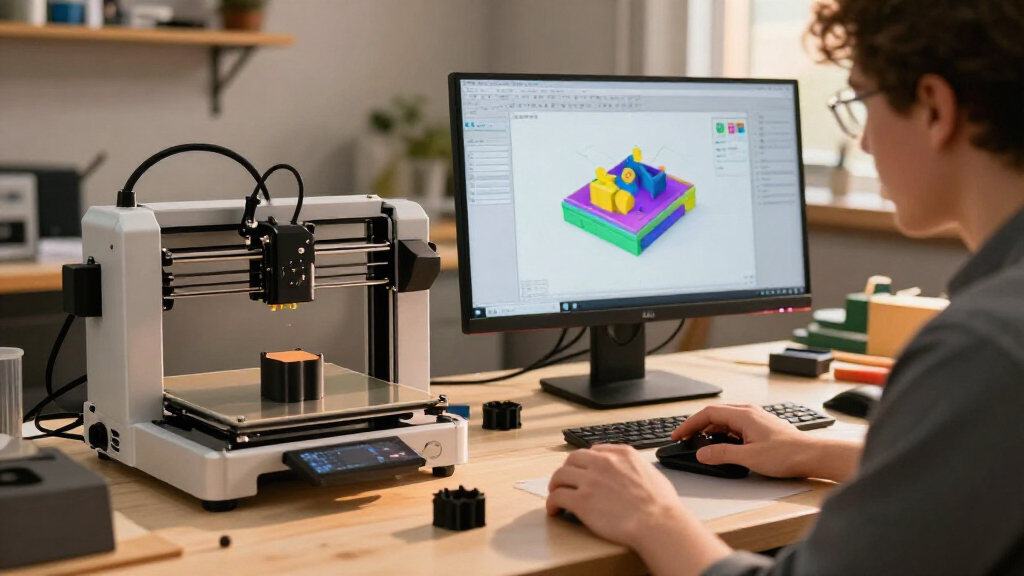
The explainer traces the process from a computer-aided design (CAD) model through simulation and slicing to printing. A slicer divides a model into layers and produces machine instructions, often called G-code. Failures can occur during fabrication, and the source notes that printing commonly involves iteration when unexpected problems arise.
Its strongest documented example is generative design work at NASA’s Goddard Space Flight Center. The article says engineer Ryan McClelland uses commercial software to propose shapes from requirements such as connection points, bolt locations, and areas that must remain clear. The software applies topology optimization, repeatedly assessing where forces travel and removing material from areas that carry less load.
For a bracket designed for NASA’s EXCITE balloon telescope, the source reports that two engineers’ conventional design took two days of effort. McClelland’s paper, as described in the explainer, reports about 30 minutes for one engineer to encode requirements and about an hour of computing for the generated design. The source also describes a Cambridge research system that uses a camera to identify and correct common errors during material-extrusion printing. It does not provide further performance figures for that system.
From idea to printed part: where AI looks over your shoulder
The orange marker shows where AI helps today. The last word still belongs to a real test.
Design: you set the loads, bolts and keep-out zones. The software proposes the shape.
Check: simulation predicts how the part bends. Only a real test shows how strong it is.
Print: a camera next to the nozzle spots common errors and corrects them during the print.
Every step: AI guesses from patterns. For parts that carry weight, people still test.
AI Can Cut Design and Print Rework
AI’s near-term value lies in assisting with defined tasks rather than replacing engineering judgment. Generative design may reduce the time spent producing candidate shapes, while printer monitoring may alert operators to issues during a job. For manufacturers and designers, those capabilities could reduce some design or print iterations, although the source does not establish an industry-wide time or cost saving.
The limits matter because an apparently workable model is not proof that a physical part is safe. The explainer says NASA’s AI-designed parts still go through stress analysis and testing. It also warns that an optimization algorithm can produce structures that are too thin. A missed load, fastener, clearance, or other requirement can lead to a convincing but unsuitable design.
For home users, printer cameras may be the most direct application, but the article frames them as an extra set of eyes, not a guarantee. For parts that carry weight, protect people, or are used in flight, human checks and physical tests remain necessary.
Popular right now

Vitamix 5200 Blender with 64 oz. Container, Black

Hisense E7 Cinema Series 65-Inch Hi-QLED Mini-LED 4K UHD Smart Fire TV

Ninja Kitchen System Pro BL770, 1500W Blender and Food Processor Combo
As an affiliate, we earn on qualifying purchases.
From CAD Model to Printed Part
The article distinguishes among several common additive-manufacturing methods: material extrusion, where a nozzle deposits melted material; resin printing, where light hardens liquid resin; and powder-based processes that use a laser or electron beam. The Cambridge example concerns material extrusion, the nozzle-based method the source describes as widespread.
AI can enter at different points in the workflow. In generative design, the human supplies constraints and the software proposes a shape. In monitoring, a camera and a model look for errors as the printer works. These are narrower applications than prompt-to-CAD: the source says text-to-CAD remains research and that executable code does not by itself establish that a part is correct.
The explainer also notes legal limits in the United States: it says purely AI-generated output does not receive copyright protection and that only humans can be named as inventors. Those statements are presented as background to the article’s discussion, not as a detailed legal analysis.
How Reliable Are These Systems?
The source does not provide independent validation data, failure rates, or broad comparisons showing how often the cited design and monitoring systems improve results across different printers, materials, and part types. It also does not specify the Cambridge system’s accuracy or the range of errors it can correct.
It remains unclear how quickly these research and engineering applications will reach everyday design software and consumer printers. The explainer says text-to-CAD is not yet a tool users can trust to produce a correct part from a sentence, but it gives no adoption timetable. No AI system described in the source removes the need to verify requirements or test a safety-relevant printed part.
Human Review Remains the Next Step
For now, designers should treat generated shapes as proposals: confirm the required loads, fasteners, clearances, and materials, then run engineering checks and test the printed part. Printer operators can use camera-based alerts as assistance, while continuing to inspect early layers and the finished print.
The source does not announce a new product launch, regulatory change, or deployment date. The next practical developments to watch are further evidence on how well monitoring systems perform outside research settings and whether text-to-CAD tools can reliably meet engineering constraints. Until then, the article’s central guidance is unchanged: AI can assist the workflow, but people remain responsible for checking the result.
Key Questions
Can AI design a 3D-printed part today?
AI design software can propose shapes when engineers specify requirements such as loads, attachment points, and areas to avoid. The source describes NASA work using generative design, but says the resulting parts still need engineering review and testing.
Can AI turn a sentence into a reliable CAD model?
The explainer characterizes text-to-CAD as research rather than a dependable tool for producing a part that can be trusted without checking. A model or code that runs does not prove that the design meets its requirements.
How can AI help while a 3D printer is running?
A camera-based system described in the source can identify and correct some common errors during material-extrusion printing. The source gives no accuracy rate or evidence that the system catches every failure.
Do AI-designed parts still need physical tests?
Yes. The article says NASA’s AI-designed parts still undergo stress analysis and testing, and it cautions that algorithms can create structures that are too thin. Safety-relevant parts need human checks and real tests.
Source: ThorstenMeyerAI.com