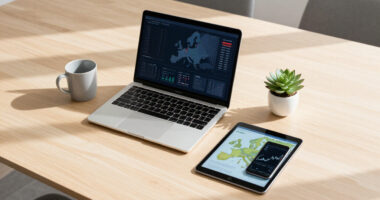

📊 Full opportunity report: Stenvrik: News as Geography on ThorstenMeyerAI.com — validation score, market gap, and execution plan.

Get business pricing on office and shipping supplies
- Business-only prices and quantity discounts
- Tax-exempt purchasing
- Multiple users, one account, clear invoices
TL;DR
Stenvrik has launched a new news platform that visualizes live stories on a 3D globe, organized by city. The system uses an autonomous trend engine to cluster stories and inform broader content strategies, all at minimal cost.
Stenvrik has launched a new news platform that visualizes live stories pinned to 49 city hubs on a rotating 3D globe, offering a geographical perspective on current events. The platform uses an autonomous trend engine to cluster stories and detect regional trends, providing a new way to understand where news is happening and why it matters. This development could reshape how news consumers and publishers interpret real-time information.
The platform, still in closed beta, presents around 1,700 live stories organized by city, with the interface enabling users to spin the globe and see regional news clusters. The underlying trend engine continuously surfacing and clustering stories operates autonomously, running on owned compute resources, which keeps operational costs near zero per month. This approach allows the platform to deliver real-time updates without significant infrastructure costs.
Beyond its visual appeal, the system feeds signals back into a broader content network, providing market intelligence that helps inform editorial decisions and regional coverage strategies. The engine’s provider-agnostic design ensures flexibility and local-first operation, making it adaptable to different data sources and models. The project originated as a low-cost prototype, demonstrating that innovative news visualization can be achieved without high infrastructure expenses.
Stenvrik — news as geography
Not what is the news — where is it happening. ~1,700 live stories pinned to 49 city hubs on a rotating globe, with an autonomous trend engine that also feeds the network.
Spin the world; the news sorts itself.
A 60fps 3D globe where every story is pinned to the city it belongs to. Clusters, gaps, regions heating up — context a vertical feed throws away.
Independent commentary, produced with AI assistance under human editorial oversight. The views are the author’s own and may change. Stenvrik is in closed beta; features, availability, and behavior may change and it is provided without guarantee of uptime or fitness for a particular purpose. The autonomous trend engine clusters and places stories programmatically and may contain errors, mis-placements, or omissions — verify independently before relying on any of it. Product and company names are trademarks of their respective owners; mention does not imply endorsement.
Geography-Driven News as a Strategic Asset
This development matters because it introduces a new method of organizing and consuming news based on geographical location, which can improve contextual understanding and regional trend detection. For publishers and news outlets, the trend engine offers valuable insights into emerging regional stories before they become widespread, enabling more targeted coverage and timely reporting. Additionally, the platform’s low-cost model demonstrates a sustainable approach to innovative news delivery in a market where infrastructure costs often hinder experimentation.
3D globe news visualization device
As an affiliate, we earn on qualifying purchases.
As an affiliate, we earn on qualifying purchases.
From Prototype to Production with Minimal Cost
Stenvrik originated as a Claude Design ‘News Globe Demo,’ a simple visualization prototype designed to show stories on a globe. Its transition to a functional product was driven by the realization that the concept could operate at nearly zero cost, thanks to client-side rendering and owned compute resources for trend detection. This approach aligns with recent trends towards lightweight, AI-driven news tools that prioritize efficiency and scalability.
The platform’s development reflects a broader shift in news technology, emphasizing geographical context and autonomous trend analysis over traditional list-based feeds. It also demonstrates how innovative visualization and AI can coexist within budget constraints, challenging the assumption that high-quality news products require substantial infrastructure investments.
“Organizing news by geography isn’t just a visual choice; it’s a fundamental shift in how we understand where stories are happening and why they matter.”
— Thorsten Meyer, creator of the platform
Unconfirmed Aspects of Platform Adoption and Impact
It is not yet clear how widely the platform will be adopted once in open access, or how users will respond to a geographical news interface compared to traditional feeds. The long-term impact on news consumption habits and publisher strategies remains uncertain, as does the platform’s ability to scale beyond the current beta stage.
Next Steps for Broader Deployment and Evaluation
Stenvrik plans to open the platform to a broader audience during the next development phase, gathering user feedback and refining the interface. Simultaneously, it will continue to enhance its trend engine’s capabilities and explore integration with existing news ecosystems. Monitoring user engagement and the platform’s influence on news coverage will be key milestones in the coming months.
Key Questions
How does the geographical news visualization differ from traditional feeds?
Instead of a list, news stories are pinned to a rotating 3D globe based on their location, allowing users to explore current events geographically and identify regional clusters quickly.
What is the role of the trend engine behind the platform?
The trend engine continuously detects, clusters, and ranks stories based on their regional significance, providing real-time signals that inform content strategies and regional coverage decisions.
Is the platform currently accessible to the public?
No, it is in closed beta, and availability is limited as the developers gather feedback and refine the system.
How does the platform keep costs so low?
The visualization runs client-side, and the trend engine operates on owned compute resources, minimizing infrastructure expenses and enabling near-zero monthly costs.
Could this approach change how news is consumed overall?
Potentially, yes. By emphasizing geographical context and autonomous trend detection, it could influence user habits and how publishers prioritize regional reporting, but broader impact remains to be seen.
Source: ThorstenMeyerAI.com
Fall Picks
fall essentials
As an affiliate, we earn on qualifying purchases.