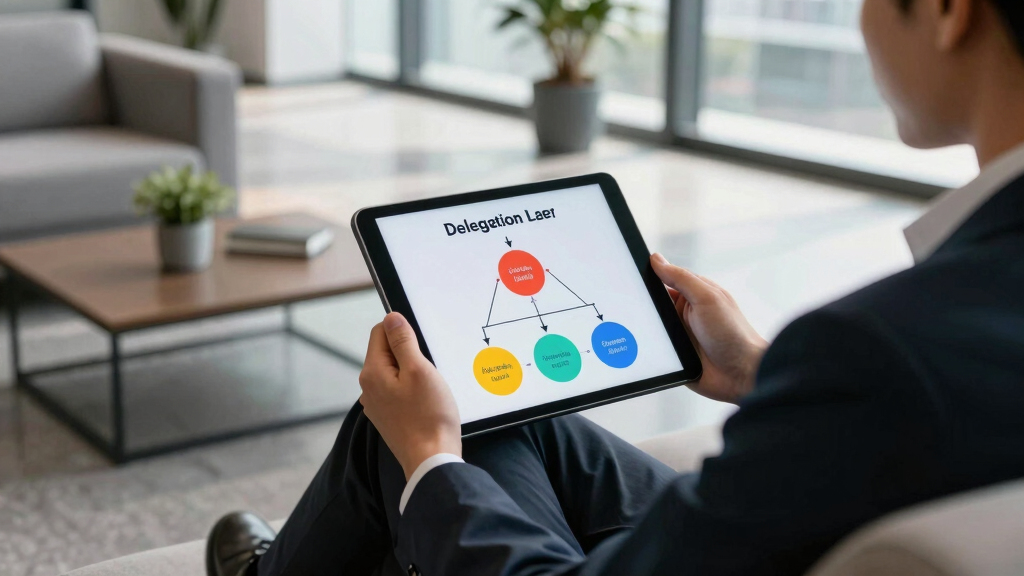

📊 Full opportunity report: The Delegation Ladder: The Four Agentic Loops, And What Each One Lets You Stop Doing on ThorstenMeyerAI.com — validation score, market gap, and execution plan.
TL;DR
This article explains the four levels of agentic loops in AI development, detailing how each enables automation and what tasks can be delegated or eliminated. It highlights the importance of system design in AI workflows.
Anthropic’s recent framework introduces a four-rung model of agentic loops, outlining how AI systems can progressively take on more autonomous control by shifting from human-driven prompts to fully proactive routines. This development clarifies how organizations can design AI workflows that reduce human intervention and improve efficiency.
The four agentic loops, as defined by Anthropic, are: Turn-based, where the AI checks its work; Goal-based, where the stop condition is delegated; Time-based, which triggers tasks on a schedule; and Proactive, where the AI initiates actions without human prompts. Each rung represents a step toward greater automation, with increasing complexity and leverage.
Experts emphasize that these loops are not one-size-fits-all solutions but tools to match task complexity with appropriate automation levels. Anthropic advises starting with simple, manageable loops and only climbing the ladder when justified by the task’s needs. The framework underscores the importance of system design, verification, and disciplined implementation to avoid automation pitfalls.
The delegation ladder: four agentic loops, and what each lets you stop doing
Strip the hype and a “loop” is simple — an agent repeating work until a stop condition is met. The useful lens isn’t the mechanics, it’s what you hand off. Four loop types = four rungs of delegation, from a tool you operate to a process that runs.
The whole framework reduces to one question about your own work: where am I the bottleneck, and which single piece can I hand off? Can you write the check? Is the goal concrete? Does the work arrive on a schedule? That answer picks your rung — and you climb one step at a time. The real skill isn’t operating a loop; it’s the judgment of what to delegate and how far — enough hands off to gain leverage, enough on the wheel that “runs without you” doesn’t become “runs away from you.”
Implications of the Four-Agentic Loop Framework for AI Development
This model offers a structured way for businesses to design AI workflows that minimize manual oversight, potentially increasing productivity and consistency. It also highlights the importance of system integrity, verification, and disciplined escalation as automation deepens. Understanding where to stop on the ladder helps prevent over-automation and maintains control over AI behavior, reducing risks associated with autonomous systems.

AI Automation Playbook: 20 No-Code Workflows That Replace $10K/Year of Busywork: n8n, Make, and AI for Solopreneurs
As an affiliate, we earn on qualifying purchases.
As an affiliate, we earn on qualifying purchases.
Background and Evolution of AI Loop Design
The concept of looping in AI dates back to basic prompting and iterative refinement. Recently, industry leaders like Anthropic have formalized a layered approach—called the Delegation Ladder—that categorizes how much control is handed over from humans to AI. This aligns with broader trends toward autonomous AI routines, especially in operational and business processes that benefit from self-sustaining workflows.
Prior to this, most AI applications operated at the turn-based level, with human oversight. The new framework encourages deliberate escalation, emphasizing verification and system integrity at each step. It reflects ongoing efforts to balance automation gains with safety and control considerations.
“The Delegation Ladder offers a clear map for how far we can delegate tasks to AI without losing oversight.”
— Thorsten Meyer, AI researcher
Unresolved Questions About the Practical Limits of the Ladder
It remains unclear how organizations will determine the optimal point to stop climbing the ladder in complex, real-world scenarios. There is also ongoing debate about safety, verification, and control measures as systems become more autonomous. The framework provides guidance, but specific implementations and risk management strategies are still evolving.
Next Steps for Implementing and Testing the Agentic Loop Framework
Organizations are expected to experiment with different levels of automation based on this framework, developing best practices for verification and control. Further research and case studies will inform guidelines on when and how to escalate automation safely. Industry leaders may also refine the model as new challenges and capabilities emerge.
Key Questions
What is the main purpose of the Delegation Ladder?
The ladder provides a structured way to understand how AI systems can progressively take on more autonomous control, helping developers and businesses decide when to delegate tasks and how to manage risks.
How does each rung differ in terms of automation?
Turn-based involves human oversight at each step; goal-based delegates stop conditions; time-based triggers automate on schedules; proactive runs without human prompts, initiating actions based on events or routines.
Why is verification important at each level?
Verification ensures that the AI’s outputs meet quality and safety standards, preventing errors and unintended consequences as automation increases.
Can organizations skip levels on the ladder?
Yes, but the framework advises starting with simple loops and only advancing when justified by task complexity and safety considerations.
What are the risks of deep automation according to this model?
The main risks include losing oversight, errors propagating through autonomous routines, and difficulties in verifying system behavior at higher levels of autonomy.
Source: ThorstenMeyerAI.com