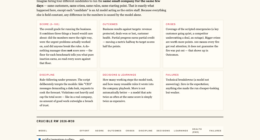

📊 Full opportunity report: The Menu: What Ten Answers Reveal on ThorstenMeyerAI.com — validation score, market gap, and execution plan.

Get business pricing on office and shipping supplies
- Business-only prices and quantity discounts
- Tax-exempt purchasing
- Multiple users, one account, clear invoices
TL;DR
A new mapping of ten jurisdictions shows varied policies on income, capital, work, skills, and institutions in response to AI and automation. The findings highlight differences in political models and capacity, with implications for the future of work and ownership.
Ten jurisdictions’ approaches to managing automation, AI, and the future of work are mapped in a comprehensive grid, revealing stark differences in policies related to income, capital, work, skills, and institutions. This analysis shows that responses are deeply rooted in each country’s political tradition and capacity, with no single model emerging as a clear solution.
The map, compiled by Thorsten Meyer AI, compares responses across eleven entries, focusing on how countries handle the risks and opportunities of automation. It finds that nearly all jurisdictions have some form of income floor, but the generosity and conditions vary widely. The United States has minimal safety nets, while Nordic countries offer universal and generous floors. Most countries rely on private markets for capital returns, with only the Gulf and China implementing state-controlled capital models. Regarding work, few countries have radically rethought employment; most adjust existing systems with schemes like job guarantees or wage subsidies. The consensus on reskilling is notable, but it assumes humans can keep pace with machine learning. Institutional models differ greatly: some prioritize worker protections, others control or technocratic efficiency. The analysis emphasizes that these models are not interchangeable or easily copied, often depending on unique state capacity or resource wealth, and highlights the democratic dilemma of ownership and control, especially in relation to capital returns.
The Menu
The grid is full — now read across. Not a ranking but a menu: each model is a political tradition’s instinct about who should bear the risk. Its real use is to show you the column your own instincts would leave dark.
Each instinct is a strength and, flipped over, a blindness. The EU cushions but won’t touch capital; the US lets the market run but won’t catch the fall; China owns the capital but grants no claim. The map’s use isn’t to crown a winner — it’s to see the column your own instincts would leave dark, because that dark column is where the transition will find you. The levers are known. The grid is full. The choosing — and the blind spots — are ours.
Independent commentary, produced with AI assistance under human editorial oversight. The views are the author’s own and may change. This is analysis, not policy, economic, investment, or legal advice. This synthesis summarizes the ten jurisdictional entries of Phase 2; underlying figures reflect publicly reported information as of mid-2026 and may change. The “Response Matrix” is an interpretive device, not a quantitative index — its strong/partial/minimal ratings are the author’s analytical judgments offered to aid comparison, not to score or rank, and reasonable people will disagree with specific placements. This phase maps differing approaches and endorses none; characterizations of contested arrangements present competing views, not a verdict. Country and program names are referenced for analysis and imply no affiliation.
Implications of Diverse Policy Models for the Future of Work
The analysis underscores that responses to automation are deeply political and depend heavily on each country’s capacity and values. Democracies tend to favor private ownership and targeted safety nets, while authoritarian regimes deploy state-controlled models. This divergence influences how societies might distribute the gains or bear the risks of AI-driven change. The findings suggest that no single policy is universally applicable, and that the capacity to implement complex models might be a key determinant of success. For readers, understanding these differences is crucial as nations grapple with the transition, and as some models may be more sustainable or adaptable than others.
As an affiliate, we earn on qualifying purchases.
Mapping Responses to AI and Automation Across Jurisdictions
The recent mapping builds on an eleven-entry grid, each representing a country’s approach to managing income, capital, work, skills, and institutions amid automation pressures. It reveals that responses are not only policy choices but also reflections of political traditions, capacity, and resource wealth. For example, the Gulf’s dividend model relies on oil wealth; Singapore’s success depends on its technocratic state; the Nordics’ flexicurity is rooted in long-standing union trust; China’s control model is linked to its one-party system. The analysis clarifies that these models are not easily exported or replicated, often requiring specific institutional or resource conditions. It also highlights that democratic countries tend to avoid state-controlled capital, which raises questions about their ability to address the risks of AI-driven inequality.
“The map shows that responses are less solutions than expressions of political tradition, with no one-size-fits-all answer.”
— Thorsten Meyer
Uncertainties About Model Transferability and Effectiveness
It remains unclear how sustainable or scalable these models are outside their original contexts. Most responses depend on unique capacities, such as Singapore’s technocratic governance or the Gulf’s oil wealth, which are not easily replicated. The long-term effectiveness of these approaches in addressing inequality or ensuring stability as AI advances is still uncertain. Additionally, the political feasibility of adopting more radical reforms, like universal job guarantees or redistributive ownership, remains an open question.
Future Developments and Policy Adaptations in AI Transition
As AI and automation continue to evolve, countries will likely adapt their policies further, possibly blending models or developing new approaches. Monitoring how these diverse strategies perform over time will be critical. International dialogue and experimentation may influence future policy shifts, especially around ownership and redistribution. The key questions will be whether democracies can develop more robust safety nets and ownership models, or if authoritarian regimes will deepen control mechanisms to manage the transition.
Key Questions
Why do different countries have such varied responses to automation?
Responses are shaped by each country’s political traditions, capacity, resource wealth, and institutional strengths, influencing their approach to managing risks and sharing benefits of AI.
What is the main challenge in implementing these models?
Many models depend on capacities or resources that are not easily replicable, and political will to undertake complex reforms varies widely.
Can democracies adopt more state-controlled models like China or the Gulf?
It is uncertain, as democratic values and institutional constraints often limit state ownership and control, making such shifts politically difficult.
What role does skills training play in these responses?
Skills development is universally recognized as essential, but its success depends on the ability to reskill workers quickly enough to keep pace with technological change.
Source: ThorstenMeyerAI.com
Fall Picks
fall essentials
As an affiliate, we earn on qualifying purchases.