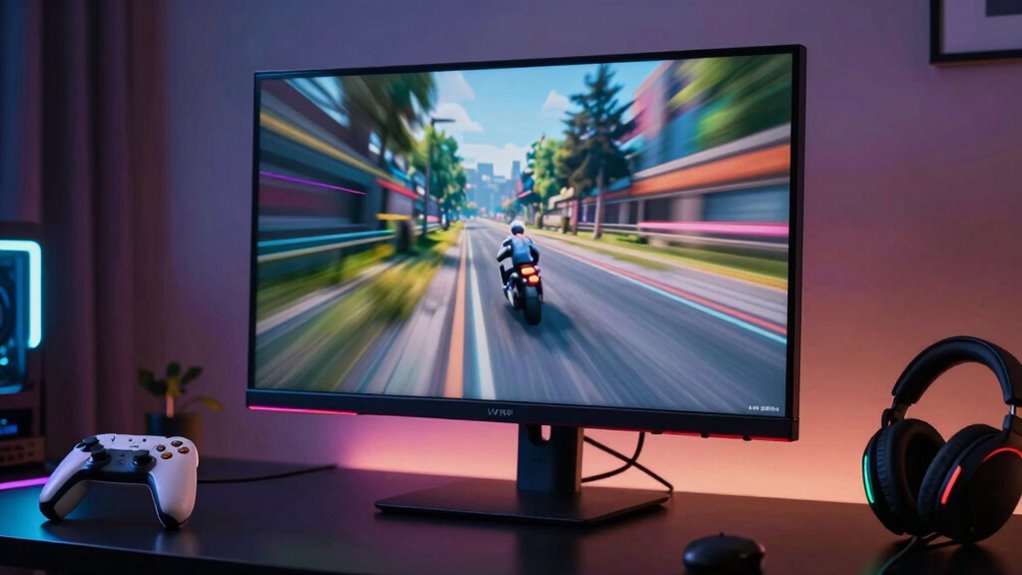

When you enable Variable Refresh Rate (VRR), your display dynamically matches its refresh rate to your graphics card’s frame output. This synchronization reduces screen tearing, stuttering, and lag, making your games look smoother and more responsive. VRR adapts in real time to fluctuating frame rates, creating a seamless visual experience. Curious about how this technology works and how to get the best out of it? Keep exploring to find out more.
Key Takeaways
- VRR dynamically adjusts the display’s refresh rate to match the GPU’s frame output, reducing visual artifacts.
- It prevents screen tearing and stuttering, resulting in smoother, more stable gameplay visuals.
- VRR reduces input lag, making games feel more responsive and responsive to quick movements.
- Technologies like FreeSync and G-SYNC enable hardware-compatible VRR, improving visual consistency.
- When VRR is enabled, your games appear significantly smoother without screen flickering or lag.

LG 24G411A-B 24-inch Ultragear Full HD (1920 x 1080) IPS Gaming Monitor, 144Hz (O/C), 1ms MBR, NVIDIA G-Sync Compatible, AMD FreeSync, HDR10, HDMI, DisplayPort, Slim Stand, Black
Vivid Color, Fast Response, Total Control – The 24" UltraGear FHD gaming monitor delivers vivid HDR10 color, ultra-smooth…
As an affiliate, we earn on qualifying purchases.
As an affiliate, we earn on qualifying purchases.
What Is Variable Refresh Rate (VRR), and How Does It Improve Gaming?
Variable Refresh Rate (VRR) is a technology that synchronizes a display’s refresh rate with your graphics card’s output, eliminating screen tearing and reducing lag. By adjusting the display’s refresh rate in real-time, VRR guarantees smooth, consistent visuals during gameplay. This process of display synchronization means your screen updates exactly when your graphics card sends new frames, preventing those distracting visual artifacts. Without VRR, a mismatched refresh rate can cause tearing or stuttering, disrupting your gaming experience. VRR dynamically adapts to your game’s frame rate, providing seamless motion and sharper images. This technology is especially beneficial during rapid scene changes or intense action, keeping your gameplay fluid and responsive. Additionally, visual consistency is maintained, which enhances overall immersion and reduces eye strain. In short, VRR makes your gaming visuals smoother and more enjoyable.

LG 32GS60QC-B Ultragear 32-inch Curved Gaming Monitor QHD (2560×1440) 180Hz 1ms 1000R AMD FreeSync HDR10 HDMIx2 DisplayPort Borderless Design Black Stabilizer DAS Crosshair FPS Counter – Black
Ascend your game with the speed of UltraGear – Experience next-level QHD gaming performance.
As an affiliate, we earn on qualifying purchases.
As an affiliate, we earn on qualifying purchases.
Why Do Gamers Love VRR? Benefits for Smoother, More Responsive Play
You’ll notice that VRR considerably reduces screen tearing, making your gameplay look smoother and more seamless. It also sharpens visual clarity, so you see details more clearly during fast-paced moments. Plus, lower input lag means your reactions feel more immediate, giving you a real edge in competitive play. Additionally, understanding refresh rates can help you optimize your settings for even better performance.
Reduced Screen Tearing
Screen tearing occurs when your display’s refresh rate and the game’s frame rate fall out of sync, causing horizontal lines and disrupting smooth gameplay. This mismatch often leads to frame skipping, making motion appear choppy. VRR helps by dynamically adjusting the display’s refresh rate to match the frame rate, reducing tearing and improving visual fluidity. Additionally, VRR is an essential digital concept that enhances gaming performance by minimizing artifacts.
Enhanced Visual Clarity
Enhanced visual clarity is one of the main reasons gamers love VRR, as it guarantees images stay sharp and smooth during fast-paced action. With VRR, your games maintain consistent motion clarity, reducing blurriness during rapid movements. This technology also preserves visual sharpness, ensuring details stay crisp even during intense scenes. As a result, your gaming experience feels more immersive and visually satisfying. You won’t notice distracting artifacts or flickering, which can ruin the moment. VRR adapts the display’s refresh rate to match the frame rate, keeping images clear and fluid. This synergy enhances overall picture quality, making gameplay more enjoyable and visually appealing. Proper display calibration also plays a role in optimizing VRR performance, ensuring the best possible image quality during gameplay.
Lower Input Lag
By syncing the display’s refresh rate with the game’s frame rate, VRR considerably reduces input lag, making your responses feel more immediate. This latency reduction means your commands register faster, giving you a competitive edge and a more seamless gaming experience. Here’s how VRR benefits you:
| Benefit | Explanation |
|---|---|
| Lower Input Lag | Faster response times improve gameplay. |
| More Precise Control | Less delay means better aiming and movement. |
| Smoother Reactions | Reduced latency makes actions feel natural. |
| Consistent Performance | Less stuttering prevents lag spikes. |
| More Responsive Play | Your inputs translate instantly to on-screen actions. |
VRR’s impact on input lag transforms gameplay, making it feel more reactive and immersive. Real-time synchronization ensures smoother visuals and a more enjoyable gaming experience.

UGREEN 8K@60Hz Active Display Port to HDMI Unidirectional Adapter with 4K@240Hz 2K@240Hz, DP 1.4 PC to HDMI 2.1 Display Male to Female Cable, Aluminum Converter Support VRR Compatible with AMD NVIDIA
8K@60Hz Visual Feast: This Ugreen Display Port to HDMI adapter supports up to 8K@60Hz and is backward supports…
As an affiliate, we earn on qualifying purchases.
As an affiliate, we earn on qualifying purchases.
How Does VRR Sync Your Display’s Refresh Rate With Frame Rates?

VRR uses adaptive refresh rate technology to match your display’s refresh rate with the frame rate generated by your GPU. This synchronization helps prevent screen tearing and stuttering, creating smoother gameplay. By adjusting the refresh rate on the fly, VRR guarantees a more consistent and responsive visual experience. Additionally, family waterpark prep emphasizes the importance of understanding display technologies to enhance your overall gaming experience.
Adaptive Refresh Rate
Have you ever experienced stuttering or screen tearing while gaming or watching videos? Adaptive refresh rate adjusts your display’s refresh rate in real-time to match your device’s frame rate, guaranteeing smooth visuals. This process enhances refresh rate optimization by dynamically syncing the display’s refresh cycle with the content’s frame output. Proper display calibration is essential for peak performance, allowing the system to respond accurately to changing frame rates. Here’s how it works:
- Continuously adapts the refresh rate based on game or video frame rate.
- Reduces tearing and stuttering for seamless gameplay.
- Ensures smooth motion even when frame rates fluctuate.
This dynamic adjustment minimizes visual artifacts and delivers a more consistent, immersive experience. Adaptive refresh rate is a core component of VRR technology, making your visuals look remarkably smoother.
Frame Rate Synchronization
Frame rate synchronization occurs when your display’s refresh rate dynamically matches the frame rate generated by your device, guaranteeing smooth and consistent visuals. This process helps maintain proper frame pacing, so frames are delivered at evenly spaced intervals, preventing jumps or stutters. Without VRR, mismatched frame rates can cause visual artifacts like tearing or judder, disrupting immersion. When your device adjusts its output to sync with the display’s refresh rate, these issues are minimized, resulting in a seamless gaming experience. This synchronization means your game’s frames are displayed at the right moments, avoiding sudden drops or spikes in frame rate that can cause discomfort. Ultimately, frame rate synchronization ensures your visuals look smooth and fluid, keeping you immersed without distracting artifacts.

ViewSonic VS3225-2K 32 Inch QHD 1440p IPS Monitor with HDMI, DisplayPort, and Variable Refresh Rate for Home and Office
VERSATILE MONITOR: 32 Inch Quad HD (2560x1440p) IPS monitor with thin bezels and 75Hz refresh rate
As an affiliate, we earn on qualifying purchases.
As an affiliate, we earn on qualifying purchases.
Major Technologies Powering VRR: HDMI VRR, AMD FreeSync, NVIDIA G-SYNC
Several key technologies enable Variable Refresh Rate (VRR) to deliver smooth, tear-free visuals. These standards adjust the display’s refresh rate dynamically to match your GPU’s output, ensuring ideal display synchronization. HDMI VRR works over HDMI connections, allowing compatible devices to communicate refresh rate changes seamlessly. AMD FreeSync uses adaptive synchronization to reduce tearing and stuttering on FreeSync-enabled monitors. NVIDIA G-SYNC, on the other hand, employs proprietary hardware and software to precisely control the refresh rate for G-SYNC-compatible displays. Each technology aims to improve gameplay fluidity by aligning the display’s refresh rate with your GPU’s frame rate, providing a smoother experience. Understanding these major technologies helps you choose the right setup for more consistent, tear-free gaming visuals.
Is Your Hardware VRR-Ready? Tips for Compatibility on Consoles and PCs
To guarantee your setup supports VRR, start by checking if your hardware is compatible with your monitor or TV. Next, make sure to enable VRR settings in your device menus and update your firmware to the latest version. Doing these simple steps helps you enjoy smoother gameplay without lag or tearing. Additionally, exploring cultural artifacts such as Indonesian masks can inspire your gaming space with unique decor elements.
Check Hardware Compatibility
Ensuring your hardware is VRR-ready is vital before enjoying smooth, tear-free gameplay. Start with compatibility checks to confirm your device supports VRR technology. Hardware limitations can prevent VRR from functioning correctly, so verifying your console or PC’s specs is essential.
- Check your monitor or TV specifications for VRR support
- Confirm your graphics card or integrated GPU supports adaptive sync
- Ensure your console firmware is up to date with VRR compatibility
Enable VRR Settings
Once you’ve confirmed your hardware supports VRR, the next step is to activate the feature in your device’s settings. On consoles and PCs, navigate to display or graphics options and turn on VRR or FreeSync/G-SYNC, depending on your system. Proper color calibration ensures accurate visuals, so check your display settings to optimize color output after enabling VRR. Keep in mind that panel technology influences how smoothly VRR performs; OLEDs and IPS panels generally handle variable refresh rates better than older TN panels. Adjust your settings for the best experience, guaranteeing your monitor or TV’s VRR compatibility is activated. This step is vital to unlock smoother gameplay and reduce artifacts, making your gaming sessions noticeably more fluid. Creating calm and organized homes can help reduce stress and improve focus, making gaming setups more enjoyable and easier to maintain.
Update Device Firmware
After you’ve enabled VRR in your device’s settings, verifying that your hardware is fully compatible is the next step. Updating your device firmware is essential for guaranteeing ideal device compatibility and smooth VRR performance. Manufacturers often release firmware updates that fix bugs, improve stability, or add support for new features, including VRR standards. To check for updates, visit your device’s official website or use the device’s built-in update feature. Keeping firmware current ensures your hardware can handle the latest VRR technologies and reduces the risk of compatibility issues. Additionally, ensuring your device supports the relevant VRR standards can improve overall performance and visual quality.
- Regularly check for firmware updates from your device manufacturer
- Follow official instructions to install updates properly
- Confirm that your device supports the latest VRR standards
How to Enable VRR on Your Monitor or TV for the Best Gaming Experience
To get the most out of your gaming experience, you need to enable Variable Refresh Rate (VRR) on your monitor or TV. Activating VRR enhances VRR benefits like smoother gameplay and reduced screen tearing. Start by accessing your device’s settings menu, usually under Display or Gaming options. Look for VRR or FreeSync/G-Sync, then toggle it on. Adjust VRR settings if available, tailoring the experience to your preferences. Use the table below to understand common options:
| VRR Setting | Description |
|---|---|
| Enabled/On | Turns VRR on for compatible games |
| Auto | Activates VRR when supported by content |
| Off | Deactivates VRR |
Enabling VRR with proper settings guarantees you enjoy a seamless, stutter-free gaming experience.
Troubleshooting Common VRR Problems: Solutions to Screen Tearing and Stuttering
Despite enabling VRR, you might still experience issues like screen tearing or stuttering. These problems can stem from high gaming latency, improper display calibration, or inconsistent refresh rates. To troubleshoot, consider these solutions:
Even with VRR enabled, screen tearing and stuttering can persist due to latency or calibration issues.
- Adjust display calibration to ensure your monitor or TV is correctly set for ideal VRR performance.
- Reduce gaming latency by closing background apps or connecting via a wired connection to minimize input delay.
- Verify your device settings to ensure VRR is enabled correctly and that your graphics drivers are up to date.
- Optimize your setup with display synchronization features to further enhance visual stability and performance.
Addressing these factors helps smooth out gameplay, minimizes tearing, and keeps stuttering at bay. Proper calibration and latency reduction are key to maximizing VRR’s benefits and enjoying a seamless gaming experience.
VRR vs. V-Sync and G-SYNC: Which Visual Tech Is Right for You?

Choosing the right visual technology depends on your gaming setup and preferences, as each option offers different advantages. VRR dynamically adjusts your display’s refresh rate, reducing screen flickering and motion interpolation issues. V-Sync limits frame rates to prevent tearing but can introduce input lag. G-SYNC combines VRR with hardware synchronization, minimizing stuttering and providing smooth gameplay. Consider your priorities: if you want minimal input lag, V-Sync might suit you; for the best smoothness, G-SYNC excels. Here’s a quick comparison:
| Feature | VRR | V-Sync | G-SYNC |
|---|---|---|---|
| Motion Interp | Reduced | Potential lag | Minimized |
| Screen Flicker | Less flickering | Possible flickering | Very minimal flicker |
| Input Lag | Low | Higher | Very low |
Additionally, understanding refresh rate synchronization can help optimize your gaming experience.
Which Games Benefit Most From VRR? Top Use Cases for Gamers
Gamers who play fast-paced, action-packed titles often see the greatest benefits from VRR technology. If your gaming setup includes quality gaming accessories and supports VRR implementation, you’ll notice smoother gameplay and reduced tearing. These benefits are especially noticeable in titles with rapid motion and high frame rate variability. Games like first-person shooters, racing sims, and fighting games benefit most because they demand quick reactions and fluid visuals. VRR helps ensure your monitor refresh rate adapts to your GPU’s output, providing a seamless experience. To maximize this, ensure your gaming accessories support VRR features. Here are the top use cases:
- Fast-paced shooters with high frame rate fluctuations
- Racing games with rapid scene changes
- Fighting games requiring precise timing and clarity
In addition, understanding the concept of visual synchronization can enhance your gaming experience by reducing visual artifacts and improving image stability.]
The Future of VRR: Trends and Innovations in Adaptive Refresh Technologies
As adaptive refresh technologies continue to evolve, the future of VRR promises even smoother and more responsive gaming experiences. Innovations like improved frame interpolation will help fill in missing frames, reducing motion blur and enhancing visual fluidity. Additionally, advanced refresh rate calibration will allow devices to precisely sync with your GPU’s output, minimizing artifacts like screen tearing. Developers are exploring smarter algorithms that adapt in real-time, optimizing VRR performance based on game complexity. We can also expect more seamless integration with display technologies, making VRR more effective across a wider range of devices. The development of home optimization techniques will further enhance overall display performance and user experience. These trends aim to deliver ultra-responsive gameplay without perceptible lag or visual inconsistencies, pushing the boundaries of what adaptive refresh technologies can achieve for gamers.
Frequently Asked Questions
Can VRR Reduce Input Lag in Competitive Gaming?
Yes, VRR can reduce input lag in competitive gaming. By synchronizing your display’s refresh rate with your GPU’s frame output, VRR minimizes screen tearing and stuttering, which helps improve gaming responsiveness. This means your inputs register more quickly and accurately, giving you a slight edge in fast-paced games. Overall, VRR enhances both visual smoothness and responsiveness, making your gaming experience more fluid and competitive.
Does VRR Work on All Types of Monitors and TVS?
VRR works on many monitors and TVs, but not all. You need to check monitor compatibility and display technology to guarantee it supports VRR. Modern displays with HDMI 2.1 or DisplayPort 1.4 often include VRR features like FreeSync or G-SYNC. Older models or budget screens may lack this support, so always verify your device’s specifications before expecting smooth, tear-free gaming with VRR.
How Does VRR Impact Battery Life on Portable Devices?
VRR can slightly impact your device’s battery life because it adjusts the display refresh rate based on content, which may increase power consumption in some cases. However, many portable devices optimize power consumption through battery optimization features, minimizing this effect. Overall, VRR‘s impact on battery life is usually minimal, especially when paired with efficient hardware and software, helping you enjoy smoother gameplay without considerably draining your device’s battery.
Are There Any Compatibility Issues Between VRR and Specific Graphics Cards?
Your graphics card might have compatibility issues with VRR if it’s not HDR or G-SYNC/FreeSync compatible. Some older or less common models may struggle with VRR technology, leading to flickering or tearing. To avoid problems, check your graphics card’s specifications and verify it supports the VRR standard your monitor uses. Updating drivers can also help resolve compatibility issues and provide a smoother gaming experience.
Will Enabling VRR Affect the Visual Quality of Non-Gaming Content?
Enabling VRR generally won’t harm the visual quality of non-gaming content. It’s designed to improve smoothness without affecting visual clarity or color accuracy. You might notice a slight difference in how static images are displayed, but overall, VRR helps maintain consistent frame rates, ensuring your videos and apps look sharp and vibrant. So, you can enjoy smoother playback without sacrificing the visual quality of your non-gaming content.
Conclusion
Embracing VRR is like tuning into a perfect symphony, where every note aligns seamlessly, creating a smooth, immersive experience. As technology advances, your gaming world becomes a canvas where frustration fades, replaced by fluid motion and sharper visuals. By understanding and harnessing VRR, you’re not just playing—you’re orchestrating a harmonious dance between your display and games, turning every session into a masterpiece of clarity and responsiveness.