
📊 Full opportunity report: Automated Food Safety Checks: The Future Of Restaurant Management on IdeaNavigator AI — validation score, market gap, and execution plan.

Get business pricing on office and shipping supplies
- Business-only prices and quantity discounts
- Tax-exempt purchasing
- Multiple users, one account, clear invoices
TL;DR
A new vision-model inspection system is being tested to automate food safety checks in restaurants by analyzing photos taken during morning walk-throughs. This development could improve accuracy and accountability in food safety monitoring, replacing traditional checklist methods.
Restaurant operators are testing a new vision-model system that automatically inspects kitchen safety during routine walk-throughs by analyzing photos taken with smartphones. This innovation aims to replace traditional checklist methods, providing verifiable, timestamped data on food safety conditions, which could significantly improve compliance and accountability, especially across multiple locations.
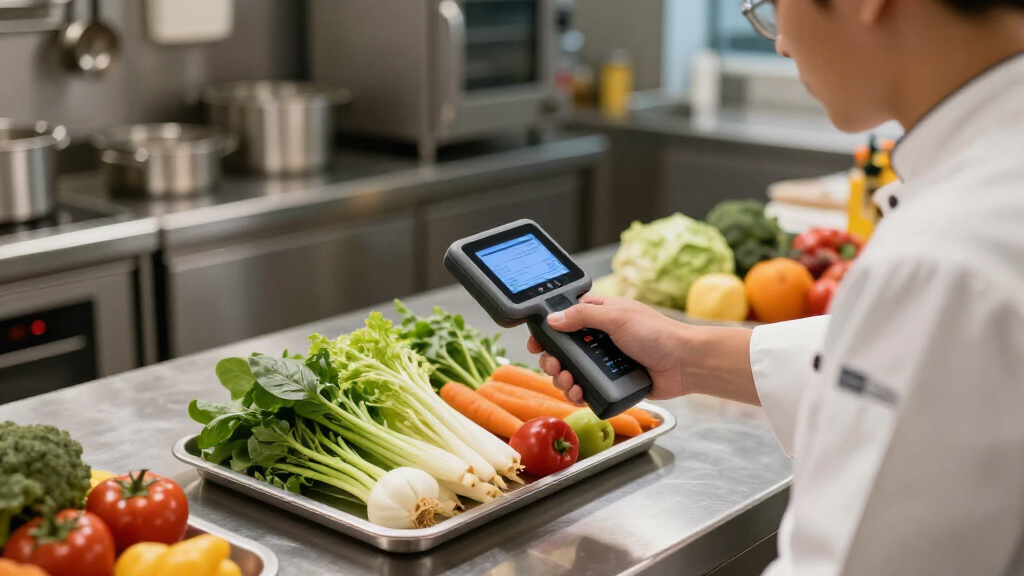
The system involves managers capturing photos of prep stations, storage areas, and sinks during morning inspections. The vision model then analyzes these images to identify violations such as uncovered containers, propped cooler doors, or missing date labels. It assigns severity ratings and generates timestamped reports, allowing for trend analysis across restaurant groups.
This approach is currently being tested at five restaurant locations over a two-week period, with results compared against findings from hired health-inspection consultants. The goal is to validate the model’s accuracy in flagging violations and its potential to streamline food safety audits without additional hardware investments.
Automated Food Safety Checks: The Future of Restaurant Management
A vision-model inspection system is turning ordinary smartphone photos into timestamped, verifiable kitchen-safety records—challenging the traditional checklist as the default tool for daily compliance.
Multi-unit restaurants are testing the system during routine morning walk-throughs.
Model findings are being compared with hired food-safety consultants.
The pilot uses existing smartphones rather than dedicated inspection equipment.
From morning walk-through to actionable evidence
Managers document real conditions as they move through the kitchen. The vision model evaluates each image, prioritizes suspected violations and converts observations into a structured report.
Capture
Managers photograph prep stations, storage areas, coolers and handwashing sinks using a smartphone.
Analyze
The vision model scans visible conditions for known food-safety risks and incomplete controls.
Prioritize
Potential issues receive severity ratings so teams can focus on the most urgent corrective actions.
Report
Timestamped findings create an auditable record for location reviews and group-wide trend analysis.
What machine vision can make visible
The core promise is not simply faster checking. It is consistent, reviewable evidence that helps operators detect recurring problems across shifts, managers and locations.
Checklist memory versus photographic proof
Traditional checklists remain useful, but their reliability depends heavily on who completes them. Automated image review adds evidence, standardization and a stronger feedback loop.
| Management criterion | Manual checklist | Vision-model inspection | Human consultant |
|---|---|---|---|
| Verifiable condition record | ~Limited | ✓Photo + timestamp | ✓Documented visit |
| Daily scalability | ✓Easy to deploy | ✓Across locations | ✗Resource intensive |
| Consistent interpretation | ✗Staff dependent | ✓Model standard | ~Expert dependent |
| Immediate corrective signal | ~If staff notice | ✓Automated flag | ~During visit |
| Regulatory authority | ✗Internal only | ✗Not established | ~Advisory expertise |
The pilot must answer three hard questions
Promising automation is not the same as proven inspection performance. Broader use depends on measured accuracy, workable restaurant integration and trustworthy data governance.
Can it match expert judgment?
The two-week trial must reveal false alarms, missed violations and performance differences across lighting, layouts and kitchen conditions.
Will teams use it correctly?
Reliable results depend on complete photo coverage, clear capture guidance and a workflow that does not slow opening routines.
Who controls the images?
Operators need defined retention, access, privacy and security policies before inspection photography becomes routine operational data.
The accountability chain
Each morning photo can become a connected operational signal—from observable conditions to group-level prevention.
Key questions, answered
The technology is designed as a verification layer for restaurant management—not yet as a replacement for professional or regulatory inspection.
What violations can it identify?
Examples include uncovered containers, missing date labels, propped cooler doors and other visible deviations captured in inspection photos.
Will it replace inspectors?
Not initially. Its intended role is to complement existing checks with consistent evidence. Replacement would require stronger validation and regulatory acceptance.
What do operators gain?
Potential benefits include more reliable compliance monitoring, lower administrative effort and comparable oversight across multiple restaurant locations.
How should photo data be handled?
Images should be restricted to compliance purposes and protected by clear storage, access and retention policies. Pilot-specific policies remain under development.
Implications for Restaurant Food Safety Monitoring
This technology could revolutionize how restaurant chains conduct daily safety checks by making inspections more reliable and transparent. Automated verification reduces reliance on subjective checklist tick-boxes and minimizes human error, potentially leading to better compliance and fewer food safety incidents. Additionally, it offers scalable, consistent oversight across multiple locations, which is critical for large restaurant groups.
smartphone food safety inspection app
As an affiliate, we earn on qualifying purchases.
As an affiliate, we earn on qualifying purchases.
Background on Food Safety Inspection Challenges
Traditional food safety inspections often depend on manual checklists filled out by staff, which may not accurately reflect actual conditions. Inspectors later identify violations during unannounced visits, but these reports are retrospective and sometimes inconsistent. Recent advances in AI and vision models have made it possible to analyze images for violations reliably, prompting interest in integrating such technology into routine operations.
The idea of automating inspections is gaining traction as restaurant groups seek more efficient, verifiable methods to ensure compliance, especially amid rising regulatory scrutiny and consumer safety concerns.
“Vision models can now reliably flag food-safety violations in ordinary phone photos, turning routine walk-throughs into verifiable inspection data.”
— an anonymous researcher
Uncertainties About Accuracy and Implementation
It is not yet clear how accurately the vision model can identify violations compared to human inspectors over longer periods or in diverse kitchen environments. The results from initial pilots are still being evaluated, and broader deployment will depend on validation outcomes and integration challenges.
Next Steps in Pilot Testing and Validation
The restaurant group plans to analyze two weeks of data from the pilot locations, comparing flagged violations with expert inspections. If results are favorable, wider rollout and subscription models could follow within the next few months. Additional testing may also explore integrating the system with existing management software.
Key Questions
How does the vision-model system work?
The system analyzes photos taken during morning inspections to identify food safety violations like uncovered food, improper labeling, or propped doors. It then generates reports with severity ratings and timestamps.
Will this replace human inspectors?
It is designed to complement existing checks by providing verifiable, consistent data. Full replacement depends on validation results and regulatory acceptance.
What are the benefits for restaurant operators?
Automated inspections can improve compliance accuracy, reduce labor costs, and provide better oversight across multiple locations with real-time data and trend analysis.
When might this technology be widely available?
If pilot results are positive, a broader rollout could occur within the next six to twelve months, with subscription plans tailored for restaurant groups.
Are there any privacy or data security concerns?
The system relies on photos taken during routine inspections, with data stored securely and used solely for compliance verification. Specific privacy policies are still being finalized.
Source: IdeaNavigator AI
Halloween Picks
halloween
As an affiliate, we earn on qualifying purchases.