📊 Full opportunity report: GLP-1 Availability And Price Transparency: A US Index on IdeaNavigator AI — validation score, market gap, and execution plan.

Get business pricing on office and shipping supplies
- Business-only prices and quantity discounts
- Tax-exempt purchasing
- Multiple users, one account, clear invoices
TL;DR
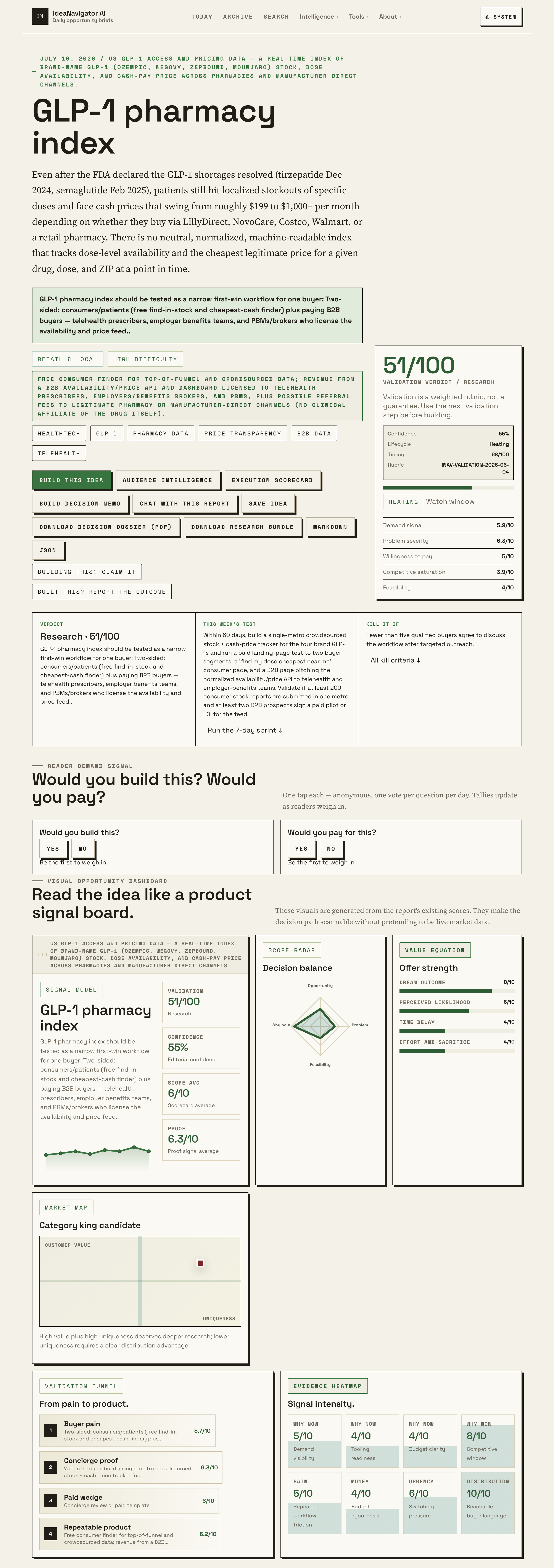
IdeaNavigator AI has outlined a proposed US index to show where four brand-name GLP-1 medicines are available by dose and ZIP code, alongside cash prices. The concept pairs a free consumer search tool with a paid data feed for health-care buyers; no operating index, buyer commitments or validation results are reported.
IdeaNavigator AI has proposed a US index that would help patients find brand-name GLP-1 medicines by dose, ZIP code and cash price, while selling normalized availability data to health-care buyers. The proposal addresses a gap left by the end of national shortage listings: patients may still encounter local gaps and widely varying prices, but the material does not report that an index has been launched or that any buyer has signed on.
The proposed consumer tool would cover Ozempic, Wegovy, Zepbound and Mounjaro. Users would search for a particular drug and dose in a ZIP code to see reported stock and compare cash prices. The proposal says initial data would combine crowdsourced stock reports with publicly available prices from manufacturer direct channels, Costco, Walmart and a price-comparison layer. It also calls for alerts when a searched dose becomes available.
On the business side, the concept would sell a normalized availability and price feed or dashboard to telehealth prescribers, employer benefits teams, benefits brokers and pharmacy benefit managers. IdeaNavigator AI suggests starting with one or two design partners. Its proposed model pairs a free consumer finder, intended to attract users and stock reports, with licensing fees and possible referrals to legitimate pharmacy or manufacturer-direct channels. The proposal does not report any referral arrangement as established.
For validation, IdeaNavigator AI proposes a 60-day test in one metro area. Its stated targets are at least 200 consumer stock reports and at least two business prospects signing a paid pilot or letter of intent. These are proposed measures, not achieved results. The material does not identify a metro or test start date, set business-access prices, or provide evidence that prospective customers have agreed to participate.
Local Supply and Price Gaps
IdeaNavigator AI argues that a dose-level index could help patients paying without insurance compare offers whose prices may vary by medicine, dose, location and purchase channel. Its proposal estimates monthly cash prices at roughly $199 to more than $1,000 across direct and retail options. The proposal does not specify a common dose, date or matched set of prices, so this estimate should not be read as a direct comparison between equivalent offers.
For employers and other buyers, the proposal identifies a different potential use: comparing local availability and cash prices when assessing access and costs. It says GLP-1s account for roughly 20% of pharmacy spending at some employers, but provides no survey, employer sample or measurement period for that figure. Whether an index would improve buyer decisions depends on data accuracy, coverage and freshness, which the material does not demonstrate.
The proposal also leaves a practical limitation: users would need to distinguish a reported listing from confirmed stock. Crowdsourced reports can become outdated as inventory changes, and listed prices may carry eligibility conditions or differ by dose. The product’s usefulness would depend on clearly communicating those limits and providing timely, comparable information.
From Shortage Lists to Fragmented Offers
IdeaNavigator AI frames its proposal around a shift from broad national shortage concerns to more localized access and price differences. The proposal says the FDA declared tirzepatide shortages resolved in December 2024 and semaglutide shortages resolved in February 2025. These dates are presented as the proposal’s account of FDA shortage-list status; they do not establish that every pharmacy had every dose in stock after those decisions.
The proposal also points to the end of compounding pathways tied to shortage conditions and the growth of manufacturer and retailer cash-pay channels, naming LillyDirect, NovoCare, Costco and Walmart. It cites the launch of the TrumpRx portal in February 2026. The material presents these developments as contributing to a more dispersed set of offers and supply reports, rather than a single shortage measure that answers whether a specific dose is locally available at a particular price.
The proposed index would bring these sources together in one search and data format. IdeaNavigator AI does not describe a current database, pharmacy integrations or a method for independently verifying stock. Its material presents an unmet information need and a possible product response, not a functioning service.
Data Quality and Buyer Demand
Because the index remains a proposal, IdeaNavigator AI reports no evidence that patients have submitted stock reports, pharmacies or manufacturers will provide inventory data, or business buyers will pay for a feed. The proposed targets of 200 reports and two business prospects would test interest in one metro, but the material does not explain how reports would be checked, how duplicate or stale entries would be handled, or how representative the results would be.
The proposal also does not explain how price comparisons would account for dose, discounts, membership requirements, insurance eligibility, fees or price changes over time. It provides no method for distinguishing a legitimate, available offer from an outdated or conditional listing. Its cash-price range is not tied to a defined observation window or a single comparison baseline.
Coverage beyond the initial metro, update frequency, consumer privacy practices and business pricing are unspecified. IdeaNavigator AI provides no evidence that telehealth providers, employers, brokers or PBMs have validated the need. Until a working test reports results, the expected usefulness and commercial viability remain unconfirmed.
A Proposed 60-Day Market Test
IdeaNavigator AI proposes a single-metro test of a consumer finder alongside a business-facing pitch for the data feed. The proposal sets benchmarks of 200 consumer stock reports and two paid pilots or letters of intent within 60 days. It does not say the test is underway, provide a launch date or name participating buyers.
If conducted, the test could indicate whether users contribute enough timely reports and whether business prospects will pay for normalized local data. The proposal does not specify what decision would follow if the targets are missed or how the service might expand to other areas. For now, the index remains IdeaNavigator AI’s proposed response to fragmented GLP-1 availability and cash pricing.
Source: IdeaNavigator AI proposal. Product details, projected prices, the employer-spending estimate, shortage-list dates and proposed test targets in this article are attributed to that proposal. It does not provide independent validation or report test results.
Key Questions
Has the GLP-1 pharmacy index launched?
No launch is reported. IdeaNavigator AI describes a proposed product and a possible 60-day test, without reporting a live service.
Which medicines would the proposed index cover?
The proposal names Ozempic, Wegovy, Zepbound and Mounjaro, searchable by drug, dose and ZIP code.
How would the index make money?
The proposed model combines a free consumer finder with paid availability and price data for telehealth providers, employers, brokers and PBMs. IdeaNavigator AI also mentions possible referral fees, but reports no commercial agreements.
What would count as a successful test?
IdeaNavigator AI proposes targets of 200 consumer stock reports in one metro and at least two business prospects signing a paid pilot or letter of intent within 60 days. These are goals, not reported outcomes.
Source: IdeaNavigator AI
Fall Picks
fall essentials
As an affiliate, we earn on qualifying purchases.