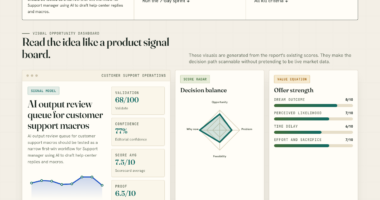

📊 Full opportunity report: Internal Resistance: The Silent Killer Of AI Projects on ThorstenMeyerAI.com — validation score, market gap, and execution plan.

Get business pricing on office and shipping supplies
- Business-only prices and quantity discounts
- Tax-exempt purchasing
- Multiple users, one account, clear invoices
TL;DR
Most enterprise AI projects fail to deliver measurable ROI due to internal resistance rather than technical issues. Organizational dysfunction and employee fears are key obstacles, with only a small fraction of pilots scaling successfully.
Internal resistance within organizations is the main factor preventing AI projects from delivering measurable value, despite widespread adoption and significant investment. Recent research indicates that organizational dysfunction, employee fears, and siloed data are the key barriers, not the technology itself.
While 72% to 88% of enterprises now have at least one AI workload in production, studies from MIT, McKinsey, Morgan Stanley, and S&P Global show that roughly 95% of these pilots deliver zero immediate profit and loss impact. Only about 16% of AI initiatives scale beyond pilots, primarily due to organizational challenges rather than technical shortcomings.
Research highlights that approximately 80% of the effort to move an AI pilot into production involves data engineering, governance, workflow integration, and measurement infrastructure—tasks related to organizational change, not the AI models themselves. Less than 1% of enterprise data is currently integrated into AI models, mainly due to data silos, governance issues, and resistance to change.
Employee fears also play a significant role: a 2026 survey found that 29% of employees and 44% of Gen Z workers admit to sabotaging AI efforts, with 64% fearing job loss and 67% suspecting data leaks from shadow AI tools. These internal dynamics make AI adoption a political and cultural challenge, not just a technological one.
Near-universal adoption, near-total value failure. The gap between spend and proof is the defining tension of enterprise AI in 2026.
Impact of Internal Resistance on AI Success
This internal resistance explains why, despite high levels of AI deployment and spending, most organizations see little to no ROI from their AI initiatives. It underscores that technological capability alone is insufficient; organizational change management and employee buy-in are critical for success. Recognizing these barriers can help companies develop more effective strategies for AI integration, reducing waste and increasing real value.
As an affiliate, we earn on qualifying purchases.
Organizational Challenges in Enterprise AI Deployment
Since 2020, enterprise AI adoption has grown rapidly, with over 80% of Fortune 500 companies running AI agents. However, success stories remain scarce. Studies from 2026 reveal that most pilots fail to scale, mainly due to internal organizational issues such as unclear ownership, lack of success criteria, and resistance to workflow changes. The real bottleneck is not the AI models but the organizational infrastructure needed to support them.
Historically, the technology has been ready; the challenge has been embedding AI into complex institutional processes. Data often remains siloed, and governance structures are resistant to change, impeding AI’s potential impact. This pattern has persisted despite the significant financial investments in AI, which totaled over $2.5 trillion globally in 2026.
"The real bottleneck was never the model. About 80% of the work is organizational — data governance, workflows, and change management."
— Thorsten Meyer
Unclear Factors Behind Resistance and Failure
While the data points to organizational resistance and employee fears as key issues, it remains unclear how best to effectively address these barriers at scale. The specific strategies that can reliably overcome internal resistance are still under development, and the impact of different change management approaches varies across industries and company cultures.
Next Steps for Improving AI Adoption Success
Organizations are likely to focus on integrating change management and employee engagement strategies, partnering with external experts, and redesigning workflows to better support AI. Further research and case studies will clarify which approaches most effectively reduce internal resistance and enable AI to deliver measurable value. Monitoring these developments will be crucial for companies aiming to realize AI’s full potential in 2026 and beyond.
Key Questions
Why do most AI pilots fail to deliver ROI?
Most pilots fail due to organizational issues such as unclear ownership, lack of success criteria, resistance to workflow changes, and employee fears, rather than the technology itself.
What is the main organizational barrier to AI success?
Data silos, governance challenges, and internal resistance—both cultural and political—are the primary barriers preventing AI from scaling effectively.
How can companies overcome internal resistance to AI?
Successful strategies include partnering with external experts, redesigning workflows, actively engaging employees, and addressing fears through transparent communication and change management.
Is the technology itself inadequate for enterprise AI?
No, studies show that the core AI technology is capable; the main challenge is organizational readiness and cultural acceptance.
What will be the focus of AI deployment efforts moving forward?
Future efforts will likely emphasize organizational change, employee buy-in, and integrating AI into existing workflows to improve scalability and ROI.
Source: ThorstenMeyerAI.com
Evergreen bestsellers Picks
bestsellers
As an affiliate, we earn on qualifying purchases.