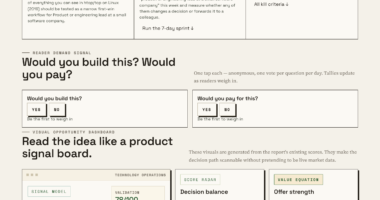

📊 Full opportunity report: QAtrial: Compliance That Shows Its Work on ThorstenMeyerAI.com — validation score, market gap, and execution plan.

Get business pricing on office and shipping supplies
- Business-only prices and quantity discounts
- Tax-exempt purchasing
- Multiple users, one account, clear invoices
TL;DR
QAtrial has unveiled an AI compliance platform designed for regulated life sciences. It emphasizes provenance tracking to meet strict regulatory requirements, supporting auditability and traceability in GxP environments.
QAtrial has launched a compliance platform specifically designed for regulated life sciences environments, emphasizing provenance and traceability for AI-assisted outputs. The platform aims to enable organizations to incorporate AI tools while maintaining regulatory auditability, a critical concern in GxP settings.
The platform, built around the principle that AI assistance must be provenance-first, records detailed information about each AI-generated output, including which model, version, and purpose produced it. Human review and electronic signatures are required before records are finalized, ensuring compliance with standards such as 21 CFR Part 11 and EU Annex 11.
QAtrial is developed privately and is not publicly available. It supports self-hosting, allowing organizations to maintain control over their data and workflows. It covers core regulated QA primitives, including CAPA workflows, electronic signatures, and traceability matrices, but explicitly states that it does not validate or certify compliance — responsibility remains with the user.
QAtrial — compliance that shows its work
You can’t put an unaccountable black box into a regulated process. So every AI-assisted output records which model produced it — reviewed, e-signed, and traceable.
no validation risk
Independent commentary, produced with AI assistance under human editorial oversight. The views are the author’s own and may change. QAtrial is developed privately and is not publicly available, and is provided “as is” without warranty. It is designed to align with frameworks including 21 CFR Part 11 and EU Annex 11 but is not validated, certified, or a guarantee of regulatory compliance, and is not legal or regulatory advice — computer-system validation and all regulatory obligations remain the user’s responsibility. AI-assisted outputs may contain errors and require qualified human review. Product and company names are trademarks of their respective owners; mention does not imply endorsement.
Implications of Provenance-First AI in Regulated QA
This development is significant because it addresses a core challenge in integrating AI into regulated environments: ensuring traceability, accountability, and auditability. By requiring detailed provenance records, QAtrial enables organizations to use AI tools without violating compliance standards, potentially reducing manual drudgery and increasing efficiency while maintaining regulatory integrity.
It also emphasizes that AI tools in regulated settings must be transparent and controllable, aligning with the regulator’s focus on data integrity and traceability. This approach could influence future standards and best practices for AI deployment in life sciences QA processes.
GxP compliance software for life sciences
As an affiliate, we earn on qualifying purchases.
As an affiliate, we earn on qualifying purchases.
Regulated QA and the Challenges of AI Integration
In regulated life sciences, quality assurance relies on validated systems that produce tamper-proof records linking requirements, tests, and results. The introduction of AI presents risks because AI outputs are often opaque, change over versions, and lack inherent traceability. Historically, this has led to resistance against AI adoption in GxP environments.
Previous efforts focused on validation and certification, but these are complex and costly. QAtrial’s provenance-first approach offers a different solution by embedding detailed records of AI assistance, aligning with existing regulatory principles without claiming validation or certification.
“QAtrial’s core innovation is making AI outputs in regulated environments fully attributable and reviewable, turning a potential liability into a manageable process.”
— Thorsten Meyer, founder of ThorstenMeyerAI.com
Uncertainties About Validation and Industry Adoption
It is not yet clear how widely QAtrial will be adopted by regulated organizations or how regulators will view its provenance-first approach in formal audits. The platform explicitly states it does not claim validation or certification, leaving questions about its acceptance in strict regulatory contexts.
Further, the effectiveness of this approach in reducing compliance risks and manual effort remains to be demonstrated through real-world deployment and feedback.
Next Steps for QAtrial and Regulatory Engagement
Organizations in regulated life sciences are expected to evaluate QAtrial’s platform for pilot projects or integration into existing QA workflows. Further development may include adding features for broader model support, enhanced usability, and formal validation pathways.
Regulators and industry bodies may also observe and potentially issue guidance on provenance-focused AI tools, influencing future standards and acceptance criteria.
Key Questions
Can QAtrial replace validated systems in regulated QA?
No, QAtrial is designed to support compliance through provenance tracking but does not claim validation or certification. Responsibility remains with the user to ensure their systems meet regulatory requirements.
How does QAtrial ensure AI outputs are auditable?
Every AI-assisted output is stamped with detailed provenance information, including model, version, purpose, and timestamp. Human review and electronic signatures finalize records, which are stored in an immutable audit trail.
Is QAtrial compatible with all AI providers?
QAtrial supports provider-agnostic architecture, currently compatible with OpenAI and Anthropic models, allowing deliberate routing and provenance tracking across different models.
Will using QAtrial guarantee compliance?
No, using QAtrial does not guarantee compliance. It is a tool to support a compliance program; validation and regulatory adherence depend on how organizations implement and document their processes.
What are the main limitations of QAtrial?
It does not validate or certify compliance and relies on organizations to interpret and integrate its features within their regulatory frameworks. Its effectiveness in real-world settings is still being evaluated.
Source: ThorstenMeyerAI.com
Fall Picks
fall essentials
As an affiliate, we earn on qualifying purchases.