
📊 Full opportunity report: Briefro: A Document That Tells The Truth on ThorstenMeyerAI.com — validation score, market gap, and execution plan.
TL;DR
Briefro has unveiled a new AI document platform that runs on users’ hardware, ensuring data privacy and accuracy. It aims to replace traditional tools for legal, finance, and client work, emphasizing trust and reproducibility.
Briefro has launched a new AI-powered document platform that operates exclusively on users’ hardware, ensuring data privacy and accuracy. This development is significant for industries like finance, legal, and healthcare, where sensitive information must remain secure and trustworthy.
The platform offers features such as data-bound figures, deterministic exports, and compliance-locked language, all running on local machines. Unlike cloud-based AI tools, Briefro ensures that no data leaves the user’s environment, addressing legal and privacy concerns for regulated sectors.
According to the company, Briefro’s design emphasizes trustworthiness by making all outputs verifiable, reproducible, and linked directly to source data. The product is shipped as a functional version 1, with some advanced features like the ‘what-if’ scenario engine still in development, currently on an unmerged branch with known bugs.
A Document That Tells the Truth
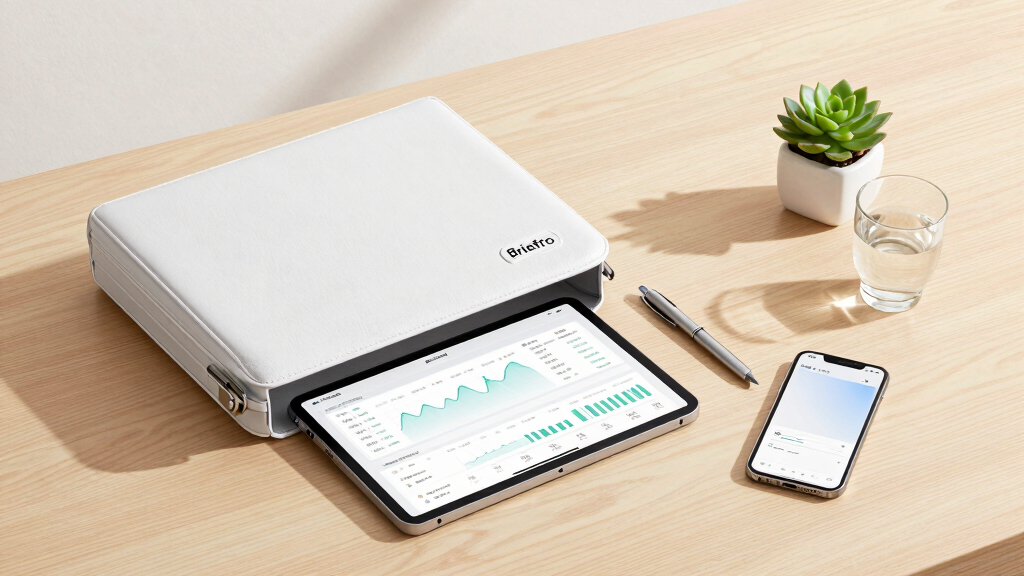
A prompt becomes a polished, branded deck, document, or proposal — where every figure is bound to your actual data, the regulated language is locked, the export is reproducible, and the whole thing is generated on hardware you own.
re-upload the data and this figure updates itself. A pasted number drifts; a bound one can’t.
The v1 contract deliberately killed the marketing site — spec written, then archived with “do not build any of it now.” The app shipped; briefro.com served nothing; four legal pages 404’d to an empty /. Subtraction taken to its end — refused until the product was real. This is the work of finally building it.
main, staged as one clean concern, committed once, and merged by PR — the dirty branch never touched.stdin, never on the command line, so the password never hit the process list.- Rotate the FTP password. It was pasted into a setup transcript, so it’s flagged for rotation as a precaution — noted, not buried.
- One-command redeploy pending. A deploy script that bakes in the control-only-TLS font trick is still to be written.
- What-if is unmerged and broken. The scenario engine reaches the KPIs but not yet the chart’s value labels; it lives on a local branch until the bug is fixed.
- Frontier vs. core. The trust architecture — local generation, data-binding, locked clauses, deterministic export — is load-bearing; some features around it are still evolving.
Independent commentary, produced with AI assistance under human editorial oversight. The views are the author’s own and may change. This is not business, financial, legal, or technical advice. Briefro is an early-stage product; some capabilities are shipped while others are in development or unmerged. Legal-page references describe templates, not advice. Infrastructure identifiers and credentials have been deliberately omitted. Product, model, and company names are trademarks of their respective owners; mention does not imply endorsement.
Why Data Integrity and Privacy Are Critical for Regulated Industries
This development matters because it provides a solution for organizations that need to maintain strict control over sensitive data while leveraging AI for document generation. By operating entirely on local hardware, Briefro addresses compliance issues that prevent many industries from adopting cloud AI tools, potentially transforming workflows in finance, legal, healthcare, and enterprise sectors.

Ollama for Private Local AI Applications: Build Offline LLM Apps, RAG Systems, Document Chatbots, Coding Agents, and Secure AI Workflows Step by Step
As an affiliate, we earn on qualifying purchases.
As an affiliate, we earn on qualifying purchases.
Background on Document Accuracy and Data Security Challenges
Traditional document tools often rely on manual copy-paste or disconnected data sources, leading to errors and outdated figures. Cloud-based AI solutions pose privacy risks and compliance hurdles, especially for regulated industries. Briefro’s approach responds to these issues by offering an offline, data-bound, and compliance-locked platform, aiming to replace multiple existing tools with a single, trustworthy solution.
“Our product is built around the core belief that trust in documents comes from their connection to real data and privacy. Running on your hardware ensures nothing leaves your environment, making AI compliant and reliable.”
— Thorsten Meyer, CEO of Briefro
Unresolved Aspects of the Platform’s Capabilities
Some features, such as the ‘what-if’ scenario engine, are still in development and have known bugs, including issues with chart labels not updating correctly. It is not yet clear when these will be fully resolved or how they will perform in complex, real-world scenarios.
Upcoming Features and Deployment Milestones
Briefro plans to release the ‘what-if’ scenario engine as an update, along with additional templates and integrations for various industries. The company will also gather user feedback to refine the platform’s stability and usability before broader adoption.
Key Questions
How does Briefro ensure data privacy?
All operations run locally on the user’s hardware, so no data leaves the device. This design prevents data breaches and supports compliance with industry regulations.
Can Briefro replace existing document tools?
Yes, it aims to consolidate slide creation, data management, and branding into one platform, reducing the need for multiple tools and manual data transfer.
What industries will benefit most from Briefro?
Regulated sectors like finance, legal, healthcare, and consulting are primary targets, where data security and compliance are critical.
Is the product fully functional now?
Yes, the core version 1 is shipped and operational, but some advanced features like the ‘what-if’ engine are still under development and have known bugs.
Will Briefro support cloud integration in the future?
The current focus is on local operation to maximize privacy and security. Future plans regarding cloud features have not been publicly disclosed.
Source: ThorstenMeyerAI.com