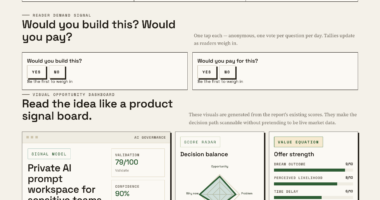

📊 Full opportunity report: Outcome-First Decisions: Keep, Change, or Kill on ThorstenMeyerAI.com — validation score, market gap, and execution plan.

Get business pricing on office and shipping supplies
- Business-only prices and quantity discounts
- Tax-exempt purchasing
- Multiple users, one account, clear invoices
TL;DR
The Outcome-First framework offers a structured approach for organizations to evaluate ongoing initiatives by focusing solely on current outcomes and costs. It aims to improve portfolio health by enabling deliberate stopping decisions, but faces challenges in measurement and emotional bias.
The Outcome-First decision framework has been introduced as an open-source tool designed to help organizations determine whether to keep, change, or kill ongoing initiatives based solely on current outcomes and costs.
The framework centers on a single question: given the current state of an initiative, is the outcome it produces worth its ongoing cost? It returns one of three verdicts: keep, change, or kill. The process is driven by the Worth Filter, which prioritizes forward-looking outcome assessment over historical investment or effort.
This approach aims to address the common problem of portfolios being burdened by long tail of projects that neither succeed nor are terminated, leading to hidden costs in focus, maintenance, and opportunity. The framework is designed to be provider-agnostic and runs on local compute, ensuring flexibility and ease of repeated use.
While the framework emphasizes the importance of stopping, it also acknowledges risks such as outcome mismeasurement, premature killing of slow-start projects, and emotional biases that can hinder decisive action. Its open-source license (AGPL-3.0) ensures transparency and encourages community development.
Outcome-First Decisions — keep, change, or kill
The hardest decision isn’t what to start — it’s what to stop. Judge every initiative by the outcome it produces now, not the effort already spent.
Independent commentary, produced with AI assistance under human editorial oversight. The views are the author’s own and may change. Outcome-First Decisions is open source under AGPL-3.0, provided “as is” without warranty; see the repository LICENSE. The framework’s verdicts are reasoning aids based on the inputs given and may be wrong — decision support, not decisions; verify independently before acting. Product and company names are trademarks of their respective owners; mention does not imply endorsement.
Why Outcome-First Decisions Impact Organizational Efficiency
This framework provides a disciplined method for organizations to prune ineffective or obsolete initiatives, freeing capacity for more valuable work. By focusing on current outcomes rather than sunk costs or emotional attachment, it promotes more rational decision-making and reduces the hidden costs of maintaining underperforming projects. Its emphasis on local, provider-agnostic operation makes it accessible for diverse organizational contexts.
As an affiliate, we earn on qualifying purchases.
The Challenge of Portfolio Bloat and Decision Fatigue
Many organizations struggle with long-standing projects that persist despite diminishing returns, often due to emotional, cultural, or sunk cost biases. Traditional decision processes tend to focus on starting new initiatives rather than systematically ending old ones. The Outcome-First framework addresses this gap by providing a structured, outcome-oriented approach to portfolio pruning, complementing existing planning and prioritization methods.
“Outcome-First decisions are about stopping the noise and focusing on what truly matters—what’s working now and worth continuing.”
— Thorsten Meyer, creator of the framework
Limitations and Risks of Outcome-First Judgments
It remains unclear how effectively organizations can implement and trust outcome measurements, especially for slow or complex initiatives. There is also a risk that outcome mismeasurement or emotional resistance could undermine the framework’s effectiveness, leading to premature or delayed decisions.
Next Steps for Adoption and Refinement
Organizations are encouraged to pilot the framework within their portfolios, refine outcome metrics, and develop cultural acceptance of stopping decisions. Further community contributions and case studies are expected to improve guidance on handling slow-start projects and outcome measurement challenges.
Key Questions
How does the Outcome-First framework differ from traditional portfolio reviews?
It focuses exclusively on current outcomes and costs, rather than past investments or effort, making stopping decisions more rational and less emotionally biased.
Can the framework be applied to all types of initiatives?
Yes, it is designed to be provider-agnostic and flexible, but its effectiveness depends on accurate outcome measurement and honest judgment.
What are the main challenges in implementing Outcome-First decisions?
Accurate outcome measurement, overcoming emotional biases, and avoiding premature killing of slow-start projects are key challenges.
Is the framework suitable for small teams or only large organizations?
It can be adapted for any size, especially since it runs locally and is open source, making it accessible for small teams to integrate into their decision processes.
Source: ThorstenMeyerAI.com
Evergreen bestsellers Picks
bestsellers
As an affiliate, we earn on qualifying purchases.