
📊 Full opportunity report: An SMB’s Guide To Finding Automation-Ready Tasks on IdeaNavigator AI — validation score, market gap, and execution plan.

Get business pricing on office and shipping supplies
- Business-only prices and quantity discounts
- Tax-exempt purchasing
- Multiple users, one account, clear invoices
TL;DR
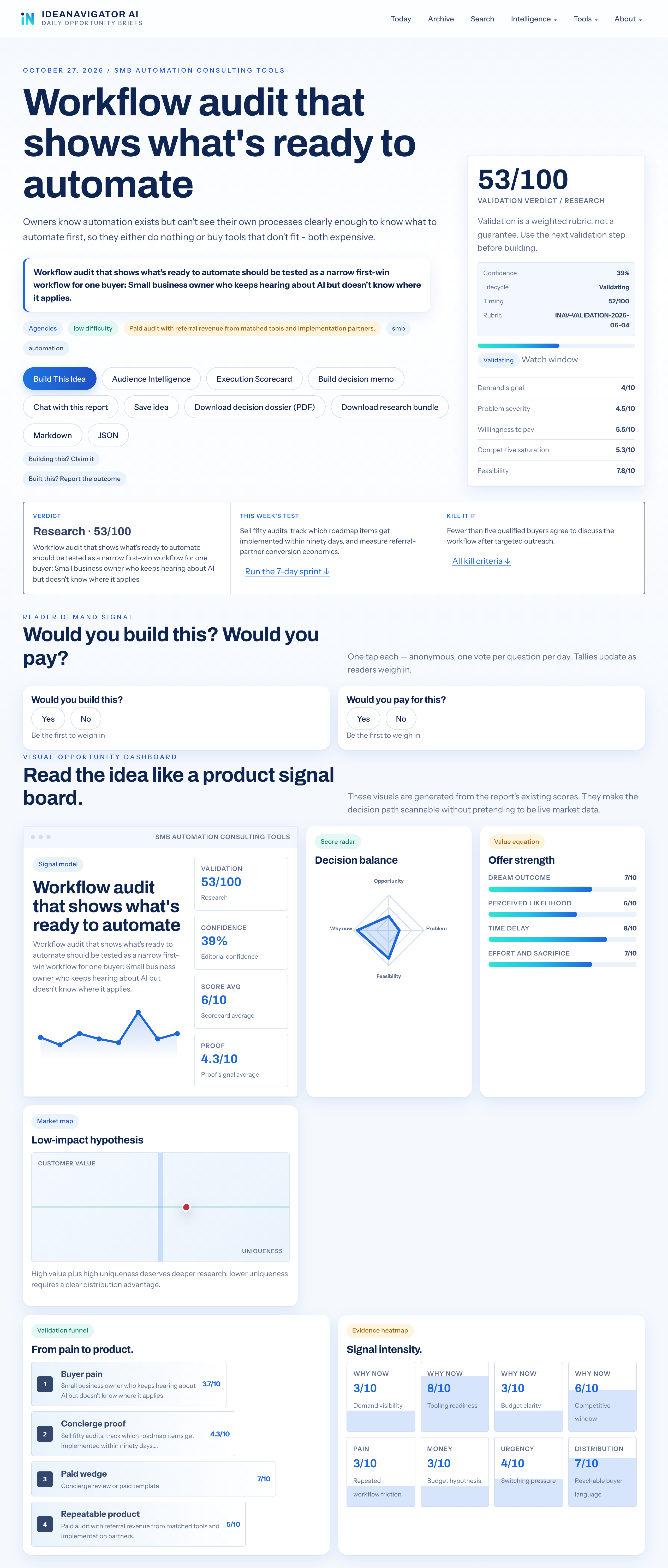
IdeaNavigator AI describes a proposed paid workflow audit for small businesses unsure where automation fits. The service would map business processes, score tasks by readiness, return and difficulty, and offer a sequenced 90-day roadmap; its demand and referral economics have not yet been established.
IdeaNavigator AI has outlined a proposed workflow-audit service to help small-business owners identify which tasks may be suitable for automation, rather than choosing tools without first mapping their operations. According to the company’s published proposal, the concept would produce a ranked process map and a 90-day implementation roadmap; no launch, customer results or validation findings were provided.
According to IdeaNavigator AI’s proposal, the audit would guide an owner through an interview about how the business operates, then organize the answers into a process map. Each process would be assessed for automation readiness, potential return and difficulty, with suggested tools matched to individual roadmap steps. The proposal does not specify how those scores would be calculated or independently checked.
IdeaNavigator AI describes the intended customer as a small-business owner who knows about AI tools but cannot see where they fit in day-to-day work. The proposal says businesses may postpone automation because they cannot identify a suitable starting point, or purchase software that does not match their processes. Those are the company’s stated descriptions of customer pain points, not measured findings.
The business model described in the proposal combines a paid audit with referral revenue from recommended software and implementation partners. IdeaNavigator AI says the validation plan calls for selling 50 audits, then tracking which roadmap items are implemented within 90 days and how often referrals convert. No audit price, partner terms, conversion figures or results are given.
Small Business · Automation Brief
An SMB’s Guide To Finding Automation-Ready Tasks
IdeaNavigator AI proposes a paid workflow audit to help small businesses map operations, assess automation opportunities, and plan next steps. The service and its commercial case remain unvalidated.
An owner interview would inform a process map, task assessments, and a sequenced roadmap.
No launch, customer results, pricing, or validation findings were provided.
Validation target
50 auditsProposed sales test
Follow-up window
90 daysTrack roadmap implementation
Assessment lenses
3 scoresReadiness · return · difficulty
Reported outcomes
None yetDemand and results are untested
From daily work to a ranked roadmap
The idea starts with how a business operates, then evaluates possible tasks before matching tools. Its scoring method and review process have not been specified.
Owner interview
Gather details about routines, handoffs, and recurring work.
Process map
Structure the answers into a view of business processes.
Task scores
Rate readiness, potential return, and difficulty.
90-day roadmap
Suggest steps and tools matched to individual needs.
A practical gap between interest and action
These are customer pain points described in the company’s proposal. They are not measured market findings.
Starting point
“Where would automation fit?”
Owners may know about AI tools but struggle to connect them to day-to-day work.
Timing
Workflows stay unchanged
Uncertainty about a suitable first task may delay decisions about automation.
Tool fit
Software can miss the process
Buying a product before understanding the workflow may lead to a poor match.
Three proposed lenses
The proposal names the dimensions but does not explain scoring rules, evidence standards, or independent checks.
Test whether recommendations lead to action
IdeaNavigator AI says the next milestone is to sell 50 audits, then observe which recommended roadmap items customers implement within 90 days and how often referrals convert.
No start date, schedule, pricing, partner terms, or trial results have been reported.
Proposal versus evidence
The concept should be treated as a proposed service and validation plan, not a confirmed product with demonstrated outcomes.
| Topic | What the proposal says | What remains unreported |
|---|---|---|
| Service | Interview, process map, task scores, and sequenced roadmap | Launch status, availability, sample audit, and who conducts reviews |
| Assessment | Readiness, potential return, and difficulty | Scoring method, validation, and independent review |
| Revenue model | Paid audit plus software and implementation referrals | Price, partner agreements, conversion figures, and conflict safeguards |
| Validation | Sell 50 audits; observe implementation over 90 days and referral conversions | Trial start, definitions, results, baseline, and productivity or savings measures |
What the outline can—and cannot—answer
The concept’s next evidence should clarify customer demand, execution, and outcomes.
Is the audit available now?
No availability or launch date is given. The description presents a concept and validation plan.
How would it make money?
The proposed model combines paid audits with referral revenue. Prices, partner terms, and conversion results are not provided.
Would it prove automation saves money?
No. The proposed test tracks implementation and referrals, without a stated method for measuring savings or productivity.
What would stronger evidence show?
Who bought audits, how scores were produced, what tasks were implemented, and whether referrals support sustainable revenue.
Source: IdeaNavigator AI proposal · No validation results provided
A Test Before Tool Purchases
The proposal targets a practical gap between interest in automation and the work of applying it: owners need to understand a process before deciding whether software can improve it. A structured review could give businesses a way to compare potential tasks and avoid treating every new AI product as a reason to change operations. Whether it does so effectively remains to be tested.
The suggested 90-day follow-up also gives the idea a measurable test beyond customer interest. Tracking actual implementation could show whether an audit produces recommendations that businesses can act on, while referral conversion would indicate whether tool and partner recommendations support the proposed revenue model. Neither measure, by itself, would establish that automation improved productivity or saved money; the outline does not specify those outcome measures.
Popular right now

Dyson Car+Boat Cordless Handheld Vacuum

Dyson Ball Animal Total Clean Upright Vacuum

Apple AirPods Pro 3 Wireless Earbuds with Active Noise Cancellation
As an affiliate, we earn on qualifying purchases.
From AI Interest to Process Mapping
IdeaNavigator AI frames the idea against the rapid expansion of AI tools, which the proposal says has left some small-business owners uncertain about what to adopt. It argues that guided interviews and process mapping may now be easier to deliver with large language models. This is the proposal’s rationale for timing, rather than evidence that an AI-led audit has already worked at scale.
The concept sits in the small-business automation consulting tools market. As described by IdeaNavigator AI, instead of starting with a particular software product, it would begin by interviewing an owner about operations and then recommend possible next steps. The distinction matters: the product being proposed is an assessment and roadmap, not a confirmed automation platform or a documented consulting service already in operation.
Demand and Results Remain Untested
IdeaNavigator AI’s published description does not say whether the audit is being built, when it might launch, who would conduct or review interviews, or how its readiness, return and difficulty scores would be produced. It also gives no pricing, sample audit, named tools, implementation partners or customer feedback. The proposed service should therefore be treated as a business concept and validation plan, not an available product with demonstrated outcomes.
The proposed 50-audit test has no reported results. The description does not clarify how “implementation” would be defined, whether businesses would be compared with a baseline, or how the service would account for differences in company size and workflow. Referral revenue could also create incentives around recommendations; IdeaNavigator AI’s outline does not describe a process for managing potential conflicts.
The Proposed 50-Audit Trial
According to IdeaNavigator AI’s outline, the next stated milestone is to sell 50 audits and observe whether customers put recommended roadmap items into practice within 90 days. The proposed test also calls for measuring referral-partner conversion economics. The company has not supplied a schedule for the trial or announced that it has started.
For the concept to move beyond a proposal, reported results would need to clarify who bought the audits, how recommendations were scored, what proportion of tasks were implemented, and whether tool referrals generated sustainable revenue. Until such information is available, demand, customer impact and the commercial model remain open questions.
Source: IdeaNavigator AI proposal
Key Questions
What is the proposed workflow audit?
IdeaNavigator AI describes a proposed service that would interview a small-business owner about operations, map processes, score tasks for automation readiness, potential return and difficulty, and suggest a sequenced roadmap.
Is the audit currently available?
IdeaNavigator AI’s description outlines a concept and a validation plan but gives no launch date or availability information. It does not confirm that customers can purchase an audit now.
How would the service make money?
The model proposed by IdeaNavigator AI combines a paid audit with referral revenue from matched software tools and implementation partners. Prices, partner agreements and conversion results have not been provided.
How would the idea be tested?
IdeaNavigator AI’s plan calls for selling 50 audits, tracking which recommended roadmap items are implemented within 90 days, and measuring referral-partner conversions. No results or start date are available.
Would the audit prove that automation saves money?
Not based on the information provided. The proposed test described by IdeaNavigator AI focuses on implementation and referrals; it does not specify a method for measuring cost savings or productivity changes.
Source: IdeaNavigator AI