Understanding wattage and SPL helps you pick the right PA speakers without falling for marketing tricks. Wattage shows how much power an amplifier can deliver, but doesn’t automatically mean louder sound. SPL indicates the maximum loudness the speaker can produce in ideal conditions, but doesn’t reflect perceived volume or sound quality. To make smart choices, you need to focus on real-world specs and how they work together. Keep exploring to learn more about getting the best sound for your needs.
Key Takeaways
- Wattage indicates amplifier power capacity, not loudness; higher wattage doesn’t automatically mean louder sound.
- SPL measures maximum loudness; higher SPL ratings suggest a speaker can produce louder sound, but perception also depends on frequency and environment.
- Don’t rely solely on peak wattage or exaggerated SPL figures; focus on RMS power ratings and real-world testing.
- Proper matching of wattage, impedance, and speaker efficiency ensures optimal loudness and prevents damage.
- Use calibrated measurements at consistent distances to accurately compare speaker loudness rather than relying on marketing claims.

ALTO TX408 350W 8" Powered PA Speaker with Bluetooth, 2-Channel Mixer, Line Level for Mobile DJs and Musicians, for Small Venues, Rehearsals and Events
Sonic Might – The most compact in the TX Series, the TX408 loudspeaker is made for any live…
As an affiliate, we earn on qualifying purchases.
As an affiliate, we earn on qualifying purchases.
What Do Wattage and SPL Really Mean for PA Speakers

Have you ever wondered what wattage and SPL really tell you about PA speakers? Wattage indicates the power your amplifier can deliver, but it doesn’t automatically mean louder sound. Instead, it’s vital to consider amplifier compatibility; pairing an underpowered amp with a high-wattage speaker can cause damage, while mismatched wattages might limit performance. SPL, or sound pressure level, measures how loud a speaker can get in a given space. Higher SPL ratings mean louder output, but they don’t reflect speaker durability. Overdriving speakers beyond their capacity risks damaging them. So, understanding wattage and SPL helps you choose speakers that match your setup, ensuring you get reliable, clear sound without overloading your equipment or risking damage. Additionally, knowing the speaker specifications can help you make informed decisions and prevent common mistakes in selecting audio equipment.
ALTO TX408 350W 8" Powered PA Speaker with Bluetooth, 2-Channel Mixer, Line Level for Mobile DJs and Musicians, for Small Venues, Rehearsals and Events
Sonic Might – The most compact in the TX Series, the TX408 loudspeaker is made for any live…
As an affiliate, we earn on qualifying purchases.
As an affiliate, we earn on qualifying purchases.
Why Higher Wattage Isn’t Always Louder: Debunking the Myth

You might assume that a higher wattage speaker automatically produces louder sound, but that’s a common misconception. The actual loudness depends on more than just wattage; amplifier efficiency plays a key role. An efficient amplifier delivers more power to the speaker with less waste, meaning you get more volume without needing higher wattage. Additionally, speaker impedance impacts how much power the speaker can handle. Lower impedance speakers draw more power from the amplifier, potentially increasing volume, but they also require compatible equipment to prevent damage. Simply put, wattage alone doesn’t determine loudness. Instead, focus on the quality of your amplifier, its efficiency, and matching speaker impedance properly to achieve maximum volume without falling for the wattage myth. Speaker efficiency also significantly influences perceived loudness, making it an important factor to consider in your setup.

ZK-1001B Bluetooth Amplifier 100W Mono AMP Mini Audio Power Amplifier Module with TWS Box Matching Function, BT/AUX/USB Input, DC 7-24V DIY Speaker System Amplifiers Kit for Home Car
HIFI MONO AMPFILIER BOARD: This ZK-1001B Mini Bluetooth audio amplifier board is a mono channel amp with 100W…
As an affiliate, we earn on qualifying purchases.
As an affiliate, we earn on qualifying purchases.
Understanding SPL and Its Impact on PA Speaker Loudness
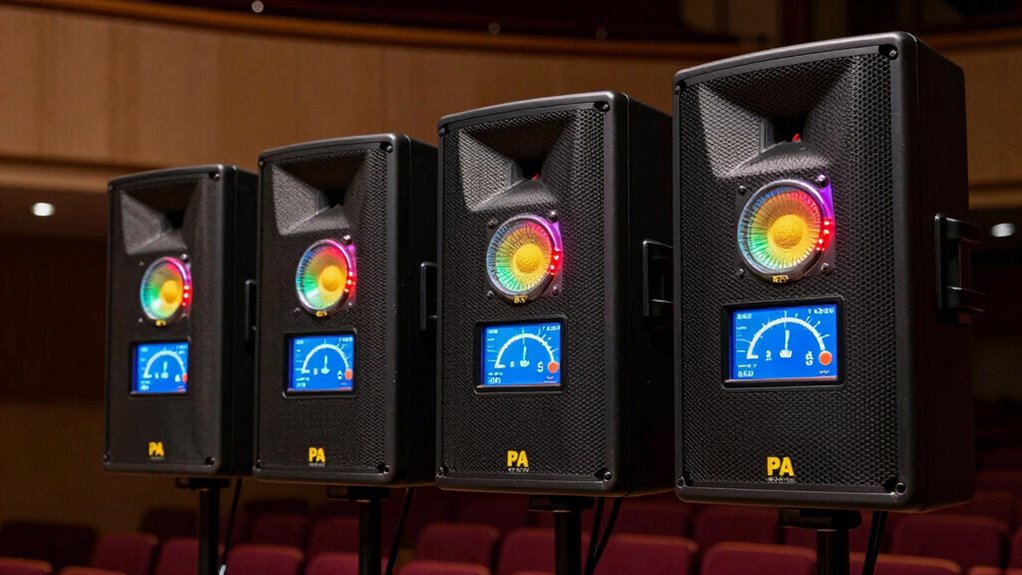
Understanding SPL measurement techniques helps you gauge how loud a PA speaker can get, which is essential for planning events. Keep in mind that SPL directly influences perceived loudness, but other factors also play a role. By mastering these concepts, you can select the right speaker for your needs and ensure clear, powerful sound. Properly applying tanning tips can also help maintain skin health during outdoor performances.
SPL Measurement Techniques
How do you accurately measure sound pressure level (SPL) to assess a PA speaker’s loudness? First, use a calibrated microphone placed at a consistent distance, ideally at ear level, in front of the speaker. To get reliable readings, consider subwoofer placement because it influences the SPL measurement; placing the subwoofer too close or far can skew results. Ensure you’re measuring on-axis, directly in front of the speaker, with no obstructions. The speaker enclosure also impacts SPL readings, as different designs affect how sound radiates. Use a sound level meter to record the SPL at a standardized distance, like one meter, and repeat measurements to account for variability. Proper technique guarantees accurate, comparable SPL measurements, giving you a true sense of your PA system’s loudness. Additionally, understanding the features of quality speakers can help interpret SPL data more effectively.
SPL and Perceived Loudness
Sound Pressure Level (SPL) is a quantitative measure of the intensity of sound, but it doesn’t always match how loud a listener perceives a speaker to be. Perceived loudness depends on psychoacoustic effects, which influence how our brains interpret sound. Factors like frequency response, harmonics, and sound quality can make a speaker seem louder or softer than its SPL suggests. For example, human ears are more sensitive to mid-range frequencies, so a speaker producing strong mids may seem louder even if its SPL is lower. Additionally, listening environment and individual hearing sensitivity can significantly alter perceived loudness. Understanding this disconnect helps you choose PA speakers that sound appropriately loud in real-world situations, rather than relying solely on SPL measurements. Recognizing psychoacoustic effects ensures you get the perceived loudness you need without overestimating a speaker’s actual power.

Rockville Power GIG RPG-122K All In One DJ/PA Package (2) 12" DJ/PA Speakers 1000 Watts Peak Power/250 Watts RMS with Built in Bluetooth, USB/SD Player, FM Tuner, Speaker Stands and a Wired Microphone
PACKAGE INCLUDES: (1) Rockville RPG122K Dual 12" Powered Speakers with Bluetooth, Mic, Speaker Stands, Cables, (1) Rockville RWM-200…
As an affiliate, we earn on qualifying purchases.
As an affiliate, we earn on qualifying purchases.
Key Factors to Consider When Comparing PA Speakers

When comparing PA speakers, you need to consider their power handling capabilities to ensure they can handle your event’s volume levels without distortion. Coverage and dispersion are also vital, as they determine how well the sound reaches your audience without dead spots. Focusing on these factors helps you choose speakers that match your venue size and sound requirements effectively. Additionally, understanding the sound quality and how it relates to the speaker’s design can significantly impact the overall experience at your event.
Power Handling Capabilities
Understanding the power handling capabilities of PA speakers is essential because it determines how loud and clear your sound system can perform without distortion or damage. When evaluating speakers, consider their power ratings to ascertain amplifier compatibility; exceeding the speaker’s capacity risks damage, while underpowering can lead to distortion. A speaker’s durability depends on its ability to handle sustained power levels without deterioration. Look for models with robust construction and clear specifications that match your amplification setup. Properly matching power handling with your amplifier prevents issues like overheating and speaker failure. Remember, higher wattage ratings don’t always mean better sound—it’s about matching the speaker’s capacity to your needs for peak performance and longevity. Additionally, understanding innovative composting toilets can inspire eco-friendly choices in other areas of your environment.
Coverage and Dispersion
Coverage and dispersion determine how well your PA speakers fill a space with sound. They impact audio fidelity by affecting how evenly sound reaches your audience. Wide dispersion ensures everyone hears clear audio, especially in large or irregularly shaped venues. Proper coverage minimizes dead zones and maintains consistent frequency response throughout the area. Keep in mind that speakers with narrow dispersion might require more units for even coverage. Factors like horn design and speaker angle influence dispersion patterns. Additionally, consider how the dispersion affects the clarity of high and low frequencies. Achieving balanced coverage ensures your sound remains crisp and natural across the venue. By understanding these factors, you can select PA speakers that deliver suitable sound distribution for any event. Recognizing how sound dispersion influences audio quality helps optimize your setup for better listening experiences.
How to Read and Interpret PA Speaker Specs Correctly
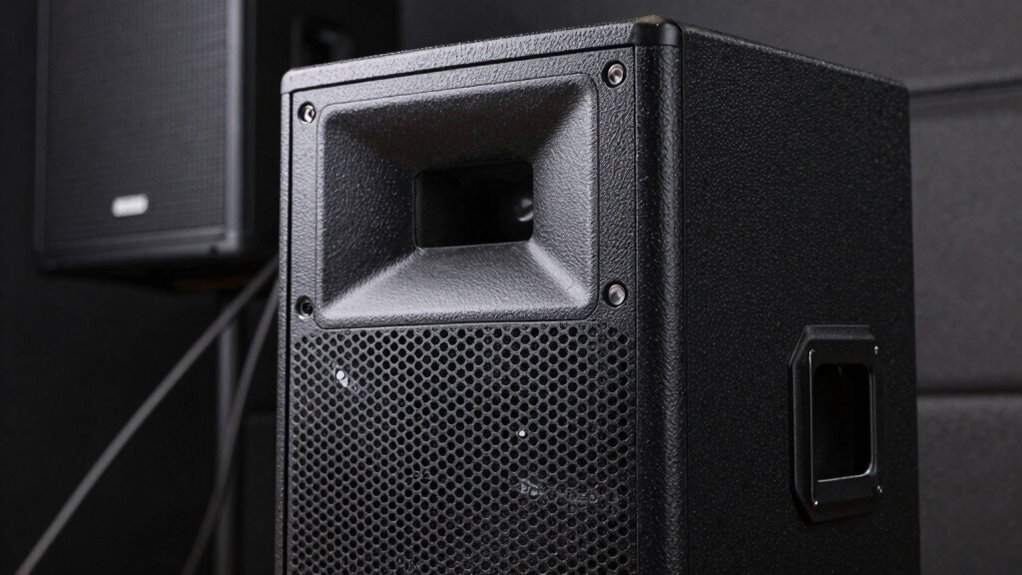
Reading and interpreting PA speaker specs can seem intimidating at first, but once you understand the key details, it becomes much easier to choose the right equipment for your needs. Focus on the frequency response, which shows the range of sounds the speaker can produce—wider ranges offer more versatility. Also, check the speaker impedance, as it affects power compatibility with your amplifier. Lower impedance speakers draw more power, increasing volume but requiring compatible gear. Here’s a quick reference:
| Specification | What it Means |
|---|---|
| Frequency Response | Range of audible frequencies (Hz) |
| Speaker Impedance | Electrical resistance (Ohms) |
| Power Handling | Maximum wattage the speaker can handle |
| Sensitivity | Loudness level at a given wattage (dB) |
| SPL (Sound Pressure Level) | Max volume output (dB) |
Understanding these specifications can help optimize your sound setup and ensure compatibility between your speakers and amplifier.
Which Specs Matter Most for Your Sound Setup

When choosing PA speakers, understanding power ratings helps you match your setup to the venue size. SPL levels indicate how loud the speakers can get without distortion, which is vital for clear sound in noisy environments. Focusing on these specs ensures you get the right performance for your specific needs. Additionally, paying attention to design considerations such as speaker placement and acoustics can significantly influence overall sound quality and coverage.
Relevance of Power Ratings
Power ratings are often the most talked-about specs when choosing PA speakers, but their importance can be misleading if you don’t understand what they really represent. While higher wattage might suggest louder sound, it doesn’t guarantee better performance or speaker durability. Instead, focus on how the power rating aligns with your amplifier compatibility to prevent damage. A speaker’s ability to handle power also affects its longevity, especially in demanding environments.
- Matching wattage with your amplifier ensures safe operation
- Higher ratings don’t always mean louder, but can indicate headroom
- Overestimating power needs risks speaker damage
- Proper ratings help maintain speaker durability over time
- Consider how power specs influence system reliability and longevity
Importance of SPL Levels
Have you considered how SPL levels directly influence the loudness and clarity of your sound setup? Higher SPL ratings mean your speakers can produce louder sound without distortion, ensuring your audience hears every detail clearly. But don’t overlook speaker placement; positioning affects how sound disperses and interacts with the room. Proper acoustic treatment minimizes reflections and echoes that can muddy your sound, making SPL more effective. Focusing solely on wattage or peak power can be misleading, so prioritize SPL for real-world performance. Remember, even the most powerful speaker won’t perform well if placed poorly or if the room isn’t treated acoustically. speaker placement and acoustic adjustments are essential to maximize SPL effectiveness. Balancing SPL with strategic placement and acoustic treatments ensures your sound setup delivers clarity, volume, and quality.
Common Marketing Tricks That Overstate Speaker Power and Loudness
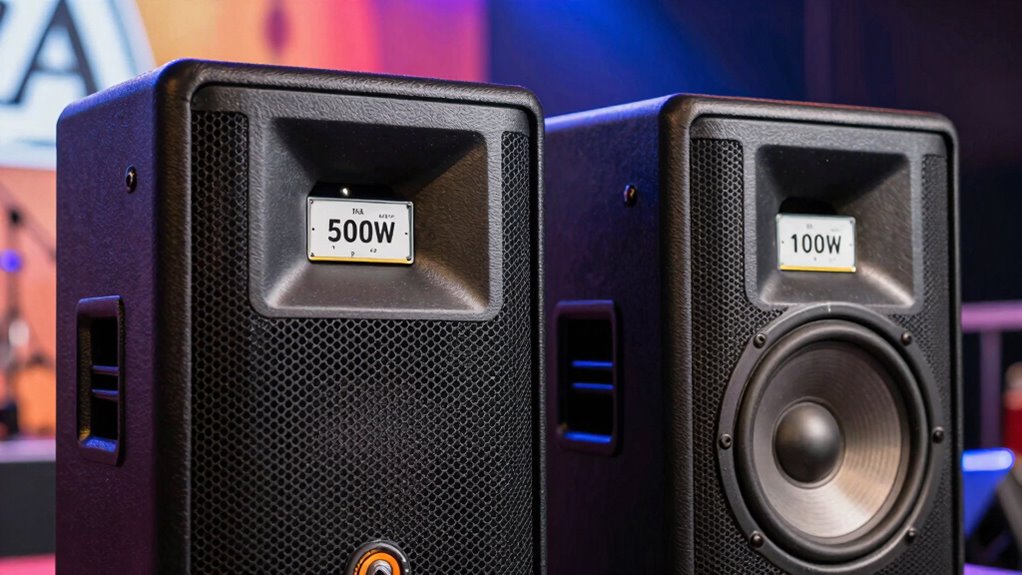
Many marketers claim their speakers deliver incredible power and loudness, but these assertions often rely on tactics that exaggerate performance. They use marketing exaggerations and branding strategies to make their products appear more impressive. You might see peak wattage numbers or SPL figures that seem unbeatable but aren’t realistic in real-world use. These tricks can mislead you into overestimating a speaker’s true capabilities.
- Highlighting peak power instead of RMS ratings
- Using exaggerated SPL ratings based on unrealistic testing conditions
- Comparing wattage figures without context
- Emphasizing brand reputation over actual specs
- Showcasing impressive specs from controlled environments
Understanding these marketing strategies helps you make smarter choices and avoid being fooled by false performance claims.
Choosing the Right PA Speakers for Different Venues and Events

Selecting the right PA speakers depends heavily on the venue size and the type of event you’re hosting. For larger spaces, you’ll need speakers with enough coverage and clarity, and proper speaker placement is essential to avoid dead zones or feedback issues. Smaller venues may require more focused, portable speakers. Consider how you’ll use audio equalization to tailor the sound to your environment, ensuring clarity without distortion. For events with speech, prioritize speech intelligibility, while concerts demand full-range speakers with higher SPL. Always test your setup beforehand, adjusting speaker placement and EQ settings to achieve balanced, even sound throughout the venue. Understanding the importance of speaker wattage and SPL can help you select equipment that meets your needs, preventing over- or under-powered setups. This approach helps you deliver a professional experience tailored to your space and audience, avoiding common pitfalls of mismatched equipment.
Practical Tips to Avoid Buying Speakers Based on Marketing Hype

It’s easy to get caught up in marketing hype when shopping for PA speakers, but relying solely on flashy claims and buzzwords can lead to poor choices. To make smarter decisions, focus on technical factors like amplifier efficiency and speaker impedance. Higher amplifier efficiency means you get more sound output for less power, saving energy and reducing costs. Understanding speaker impedance helps you match your amplifier to avoid damage and optimize performance. Be wary of exaggerated SPL figures and wattage claims that don’t consider real-world conditions. Instead, evaluate the following:
- Check speaker impedance compatibility with your amplifier
- Prioritize amplifier efficiency over wattage hype
- Test speakers in real-world environments
- Look for objective specifications, not just marketing claims
- Consider total system performance, including cabling and setup
Staying informed helps you avoid marketing traps and choose speakers that truly meet your needs.
Real-World Examples: Wattage vs SPL in Different Sound Settings

When choosing PA speakers for different sound environments, understanding how wattage and SPL relate in real-world settings can prevent misjudging a system’s performance. For example, at a small outdoor concert, higher SPL is essential for sound coverage, but wattage alone won’t guarantee sound quality if the brand’s reputation is poor. Conversely, in a conference room, moderate wattage with good sound clarity matters more than raw power. Here’s a quick comparison:
| Setting | Key Focus | Wattage & SPL Role |
|---|---|---|
| Outdoor concert | High SPL for coverage | Higher wattage boosts SPL, but quality depends on brand reputation |
| Indoor event | Sound quality and clarity | Moderate wattage with good sound design improves experience |
In real-world settings, sound quality and balance matter more than wattage alone, and reputable brands ensure consistent sound quality.
Frequently Asked Questions
How Does Speaker Efficiency Affect Perceived Loudness?
Speaker efficiency directly impacts perceived loudness because higher sensitivity ratings mean the speaker produces more sound with less power. When you look at sensitivity ratings and power handling, you’ll notice that a more efficient speaker sounds louder at the same wattage. This means you don’t need as much power to achieve high volume levels, making it easier to get the sound you want without overloading the speaker.
Can a Lower Wattage Speaker Outperform a Higher Wattage One?
Think of your speaker as a race car; wattage isn’t everything. A lower wattage speaker can outperform a higher wattage one if it has better driver size and efficiency, like a well-tuned engine. Power handling matters, but driver size impacts how much sound the speaker can produce without distortion. So, don’t just chase wattage—consider how well the speaker’s design and driver size match your needs for clear, loud sound.
What Role Does Speaker Placement Play in Loudness?
Speaker placement greatly impacts loudness; positioning your speakers at the right height and angle guarantees sound projects effectively. Elevate speakers to minimize sound reflection off surfaces like floors or furniture, which can diminish volume and clarity. Proper placement reduces sound reflection issues and directs sound toward your audience, making the system seem louder and more powerful without needing extra wattage. Adjusting height and positioning is key to maximizing loudness naturally.
How Do Room Acoustics Influence SPL and Wattage Performance?
Room acoustics profoundly influence SPL and wattage performance. When your space has high room resonance, sound waves bounce excessively, causing uneven loudness and distortion. Sound absorption materials help reduce reflections, allowing your speaker’s wattage to effectively produce clearer, louder sound. By managing room resonance and incorporating absorption, you’ll maximize SPL without needing extra wattage, ensuring your system sounds balanced and powerful in any environment.
Is Higher SPL Always Better for Outdoor Events?
Higher SPL isn’t always better for outdoor events; think of it as a roaring lion versus a gentle breeze. While loudness helps you reach distant crowds, it can strain your speaker’s durability and spike power consumption, risking damage. Focus on balanced SPL and wattage, ensuring your gear performs reliably without burning out. A well-matched speaker delivers clear sound, keeps your setup safe, and saves energy for the long haul.
Conclusion
Remember, higher wattage doesn’t always mean louder—SPL is the real measure of a speaker’s volume. Did you know that a 1000-watt amp doesn’t necessarily outperform a 500-watt one in loudness? By understanding specs and avoiding marketing tricks, you can choose speakers that truly suit your needs. So, next time you’re shopping, focus on SPL and real-world performance—your sound system will thank you.