📊 Full opportunity report: The City That Watches Itself: The Living Digital Twin, And The God’s-Eye View We’re Building on ThorstenMeyerAI.com — validation score, market gap, and execution plan.

Get business pricing on office and shipping supplies
- Business-only prices and quantity discounts
- Tax-exempt purchasing
- Multiple users, one account, clear invoices
TL;DR
Cities are creating dynamic digital twins that monitor and simulate urban environments in real time, enabled by advanced sensors and AI. This development enhances planning but also introduces significant surveillance risks.
Cities are increasingly deploying dynamic digital twins, virtual models that mirror real-time urban activity through integrated sensors and AI. These models can answer complex questions about city operations and support planning, but they also serve as powerful surveillance tools, raising privacy and sovereignty issues, according to recent analyses.
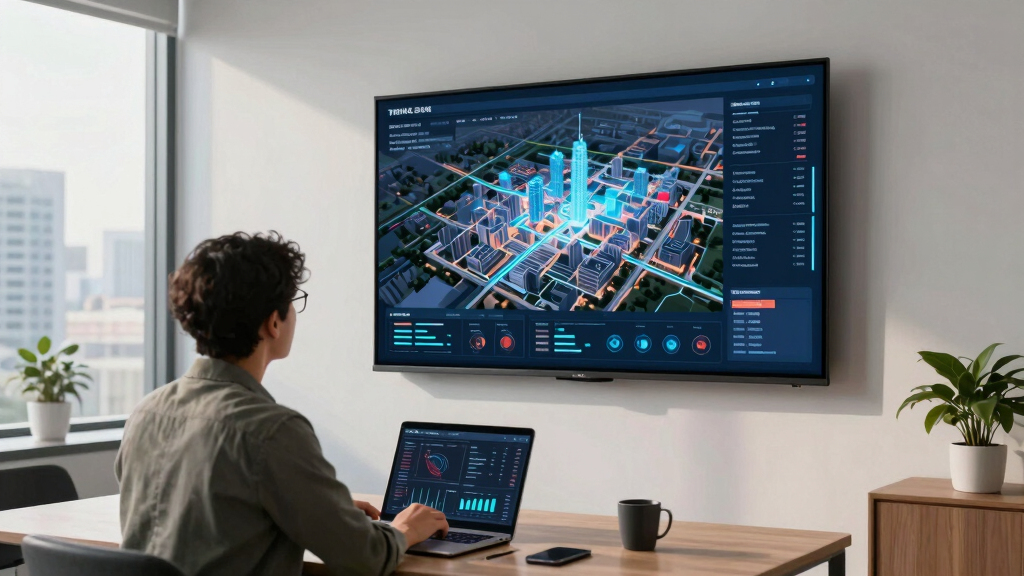
Urban digital twins are sophisticated, three-dimensional virtual replicas of cities that compile data from IoT sensors, satellite imagery, GIS, and utility networks. Unlike static maps, these models update continuously, reflecting real-time conditions and enabling predictive simulations. Singapore’s Virtual Singapore exemplifies this technology, modeling every building, road, and utility with live overlays and expanding into underground infrastructure.
Recent technological convergence has made these models more dynamic. Wide-Area Motion Imagery (WAMI) sensors now track every vehicle and pedestrian across entire cities, archiving movement data that can be rewound and analyzed. When fused with all-weather radar, satellite imagery, and AI capable of understanding heterogeneous data, the city’s digital twin becomes a comprehensive, real-time record of urban life.
Experts emphasize that the breakthrough lies in AI’s ability to interpret vast, complex data streams. Frontier models like GPT-5.6 can understand scenes, recognize patterns, and respond to natural language queries, transforming the twin from a passive dashboard into an interactive oracle. However, this also introduces risks related to data sovereignty, as some cities rely on foreign AI providers, potentially endangering critical infrastructure security.
The city that watches itself: the living digital twin, and the god’s-eye view we’re building
Soon most cities will exist twice — once in concrete, once as a live data model you can rewind, simulate, and question in plain language. Persistent sensing + frontier AI turn the planner’s digital twin into an oracle. The most useful thing we’ve built — and the most powerful surveillance instrument. Both at once.
- Plan better — cities & rural: traffic, zoning, energy, land use
- Emergency response — route crews, one live picture, ~50% faster
- Disaster resilience — simulate, track live, assess damage in hours
- Mass surveillance — track everyone, retroactively, forever
- Pattern-of-life — AI links movements, infers associations
- Social control — no warrant, no suspicion (cf. Baltimore, 2021 ruling)
We’re building a city that watches itself, remembers everything, and can be asked anything. The technology won’t choose between saving lives and ending privacy — we will, through the rules we write now, while the twin is still under construction and the defaults haven’t yet hardened into permanence. WAMI and the living twin open our lives to a view from the heavens that, from the dawn of civilization until a heartbeat ago, was reserved for gods and stars. The question is no longer whether we can see everything — it’s who gets to look, and who watches the watchers.
Implications for Urban Planning and Surveillance
The development of self-watching city twins offers substantial benefits for urban planning, allowing for more accurate, faster decision-making and resource allocation. Cities like Singapore report shorter planning cycles and fewer overruns. These models also extend to rural areas, supporting agriculture, infrastructure management, and environmental monitoring.
However, the same technologies pose significant surveillance concerns. The ability to track individual movements, analyze behaviors, and simulate emergencies in real time creates a powerful instrument that could be misused for invasive monitoring or authoritarian control, especially if access is restricted or foreign-controlled.
Popular right now

De'Longhi Stilosa Compact Manual Espresso Machine with Milk Frother

Bose QuietComfort Headphones (2nd Gen), Wireless Noise-Cancelling Over-Ear Headphones, Eucalyptus Green

KitchenAid Artisan 5-Quart Tilt-Head Stand Mixer, KSM150PS, Almond Cream
As an affiliate, we earn on qualifying purchases.
Technological Convergence Enabling Self-Monitoring Cities
The concept of digital twins has evolved from static models used in urban planning to dynamic, real-time replicas driven by advances in sensor technology, satellite imaging, and AI. Singapore’s Virtual Singapore, launched after severe flooding in 2012, was among the first to model entire cities in 3D with live data overlays. Today, other cities like Helsinki and Las Vegas operate operational city twins, with proven savings and efficiency gains.
The recent integration of Wide-Area Motion Imagery (WAMI) sensors, capable of tracking all moving objects across an entire city, significantly enhances these models. When combined with synthetic-aperture radar and AI, the twin becomes a continuous, comprehensive record of urban activity, enabling both predictive planning and real-time monitoring. The key leap has been AI’s ability to understand and interpret the flood of heterogeneous data, transforming raw feeds into actionable insights.
“Our virtual twin has shortened planning cycles and reduced costs, but we remain cautious about data privacy and sovereignty.”
— Singapore urban planner
Unresolved Privacy and Sovereignty Concerns
While the technological capabilities are advancing rapidly, it remains unclear how governments will regulate access to these digital twins, especially when foreign AI providers are involved. The potential for misuse or unauthorized surveillance is a significant concern, and legal frameworks are still evolving.
Additionally, the security of critical infrastructure data stored and processed through these models is not yet fully assured, raising questions about vulnerability to cyberattacks or geopolitical exploitation.
Future Developments and Regulatory Challenges
Cities will likely continue expanding their digital twin capabilities, integrating more sensors and AI features. The focus will be on balancing the benefits of improved urban management with safeguards against privacy invasion and data sovereignty issues. Regulatory frameworks and international agreements may emerge to govern the use and access of these models, but their development remains uncertain.
Further technological advances could also lead to more autonomous city management systems, raising questions about human oversight and accountability.
Key Questions
How do digital twins improve city planning?
They allow planners to simulate and analyze the impact of changes before implementation, reducing errors, costs, and delays by testing scenarios in a virtual environment.
What are the main risks associated with city digital twins?
The primary concerns include privacy violations, unauthorized surveillance, data security vulnerabilities, and dependence on foreign AI providers that could threaten infrastructure sovereignty.
Are these digital twins used in real emergencies?
Yes, some cities use their digital twins to simulate disaster scenarios like floods or evacuations, improving preparedness and response times.
Will residents be able to access or see these digital models?
Typically, access is restricted to city officials and planners, but transparency policies are evolving, and public awareness of these systems is increasing.
What legal protections exist for data collected by city twins?
Legal frameworks are still developing; some cities have privacy laws, but comprehensive regulations specific to digital twins are not yet widespread.
Source: ThorstenMeyerAI.com