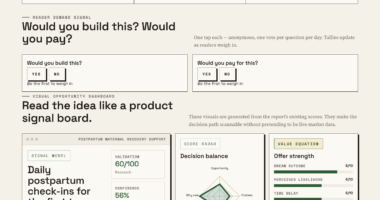
📊 Full opportunity report: Health Trend: Viral Injections Halt Pancreatic Cancer on IdeaNavigator AI — validation score, market gap, and execution plan.

Get business pricing on office and shipping supplies
- Business-only prices and quantity discounts
- Tax-exempt purchasing
- Multiple users, one account, clear invoices
TL;DR

The material describes a proposed monitoring product for consumer-health and food-brand safety teams, not a verified medical advance. It offers no study, clinical records or attributable medical source to support the claim that virus injections halted pancreatic cancer in three patients.
The material describes a proposed health and safety monitoring service for consumer-health and food-brand compliance teams, using the headline “Pancreatic cancer halted by virus injection in three patients” as an example. The proposal, published by IdeaNavigator AI, provides no clinical study, hospital record, researcher statement or publication to establish that the treatment halted cancer in three people, so the medical claim remains unverified here.
The IdeaNavigator AI proposal is aimed at a safety or compliance lead who needs to identify health, safety and contaminant developments that could affect a company’s work. It argues that such information can appear across news coverage, online forums and regulatory filings, making it difficult for a particular professional to distinguish relevant developments from general discussion.
The suggested minimum product would monitor Hacker News and similar feeds, filter items for that audience, and produce short briefs outlining what changed, why it might matter and what action could follow. The pancreatic-cancer headline is presented in the proposal as an example for the service, not as a medical finding documented there.
The proposal says Hacker News surfaced the item with an 88/100 signal. It does not explain how that score was calculated, what it measures, or whether it reflects medical credibility, reader engagement or relevance to compliance work. It also proposes testing the service by sending the example brief and two other findings to five prospective users and recording whether they change a decision or share an item with a colleague.
Viral injection headline remains unverified
The material proposes a monitoring service and offers no clinical evidence that virus injections halted pancreatic cancer in three patients.
What the proposal describes
IdeaNavigator AI frames a subscription briefing service for consumer-health and food-brand safety teams.
Filtered health signals
Monitor Hacker News and similar feeds, then summarize what changed and what action may follow.
Subscription briefings
The material describes a product hypothesis, not an operating service or demonstrated demand.
Medical claim lacks evidence
The proposal provides no clinical study, patient records, named researchers, publication or treatment details.
- Which virus or treatment was used
- Clinical setting and patient details
- Outcome measures and follow-up
- The headline cannot be confirmed from this material
- A feed alert or score does not verify a medical claim
- Do not use it as a basis for treatment decisions
How the service might be tested
The proposal suggests a small user test; it reports no completed interviews or results.
Include this example and two other health, safety or contaminant findings.
Target people matching the proposed safety or compliance buyer profile.
Record whether a brief changes a decision or is shared with a colleague.
A Medical Claim Needs Clinical Evidence
The distinction matters because a headline suggesting that a cancer was “halted” can sound like evidence of an effective treatment. The IdeaNavigator AI proposal gives no details about the patients, the virus, the injection, the clinical setting, the length of follow-up or how outcomes were measured. Without those details, readers cannot judge what happened or whether the result was caused by the treatment.
For a consumer-health or food business, a monitoring tool could help staff notice emerging issues sooner. But early detection is not verification: a feed alert or high score does not establish that a health claim is accurate, clinically meaningful or relevant to a company’s products. A compliance team would need to check the underlying reporting and assess its actual implications before acting on it.
The proposal’s value is therefore a product hypothesis, not evidence of medical impact or business demand. Its suggested user test could show whether professionals find briefings useful, but the proposal reports no completed interviews, decisions changed, subscriptions or measured outcomes.
Popular right now

De'Longhi Magnifica Evo Fully Automatic Espresso Machine with Milk Frother, Silver

Ninja Foodi Smart 6-in-1 Indoor Grill and Air Fryer, 4 qt, FG551

Dyson Cyclone V10 Origin Cordless Vacuum
As an affiliate, we earn on qualifying purchases.
The Proposal Behind the Headline
IdeaNavigator AI frames the idea as a consumer health and safety signal monitor, built for one initial buyer: a safety or compliance lead at a consumer-health or food brand. The proposal identifies its problem as relevant findings being spread across multiple sources and not necessarily presented in a role-specific way.
Its proposed response is a same-day, filtered summary rather than a generic weekly roundup. The proposed business model is a subscription, and the suggested first test is a small, hand-delivered set of briefs to five people matching the intended buyer profile. These are plans and proposed validation steps; the IdeaNavigator AI material describes no operating product or market-test results.
The proposal does not accompany the pancreatic-cancer example with a link to a clinical paper, a named research institution, a trial registration or a date. The supplied details are therefore insufficient to identify the alleged treatment or compare the headline with a medical record.
Treatment Details Remain Unreported
The IdeaNavigator AI material does not identify which virus was injected, who administered it, where the patients were treated, or whether the cases were part of a clinical trial. It provides no patient characteristics, cancer stage, treatment history, definition of “halted,” follow-up period, adverse-event information or independent assessment.
It is also unclear from the material whether the headline refers to a published study, a preliminary observation, a news report or an unverified online post. No medical experts or patients are quoted. The claim should not be read as proof that a virus injection cures pancreatic cancer or as a basis for treatment decisions.
For the proposed monitoring service, the scoring method, feed coverage, review process and safeguards against false or misleading health claims are unspecified in the proposal. The material does not establish that the proposed service has been built, that prospective users have tested it, or that any buyer has agreed to pay.
Verify the Claim, Then Test Demand
The immediate reporting step is to locate the original medical report behind the headline and check its publication status, authorship, patient details and outcome measures. The IdeaNavigator AI proposal does not identify that report. Until it is found, the claim that injections halted pancreatic cancer in three patients remains unsupported by the information provided.
Separately, the proposal calls for delivering three short health, safety and contaminant briefs to five potential users and tracking whether any briefing changes a decision or is forwarded. No date or results are given for that test. Any follow-up on the business idea would need to distinguish evidence that a brief was noticed from evidence that it was accurate, useful and worth paying for.
Further details about the alleged treatment, any clinical publication, the monitor’s development and the proposed user test have not been provided by IdeaNavigator AI.
Source: IdeaNavigator AI
Key Questions
Did virus injections halt pancreatic cancer in three patients?
The IdeaNavigator AI proposal uses that wording as a headline but provides no clinical evidence or patient records to verify it. The claim cannot be confirmed from the information available here.
What virus or treatment was used?
The proposal does not identify the virus, injection, treatment setting or clinical protocol. It also gives no publication or trial reference.
What is the proposed monitoring service?
According to the IdeaNavigator AI proposal, it is a subscription service that would scan Hacker News and similar feeds, filter health and safety findings for consumer-health and food-brand compliance staff, and prepare short action-oriented briefs.
Has the monitoring product been tested with customers?
The IdeaNavigator AI proposal reports no completed customer test. It suggests sending briefs to five prospective users and measuring whether they change a decision or share an item.
Source: IdeaNavigator AI