
📊 Full opportunity report: How Creators Can Organize Social Media Projects With Tasks on IdeaNavigator AI — validation score, market gap, and execution plan.

Get business pricing on office and shipping supplies
- Business-only prices and quantity discounts
- Tax-exempt purchasing
- Multiple users, one account, clear invoices
TL;DR
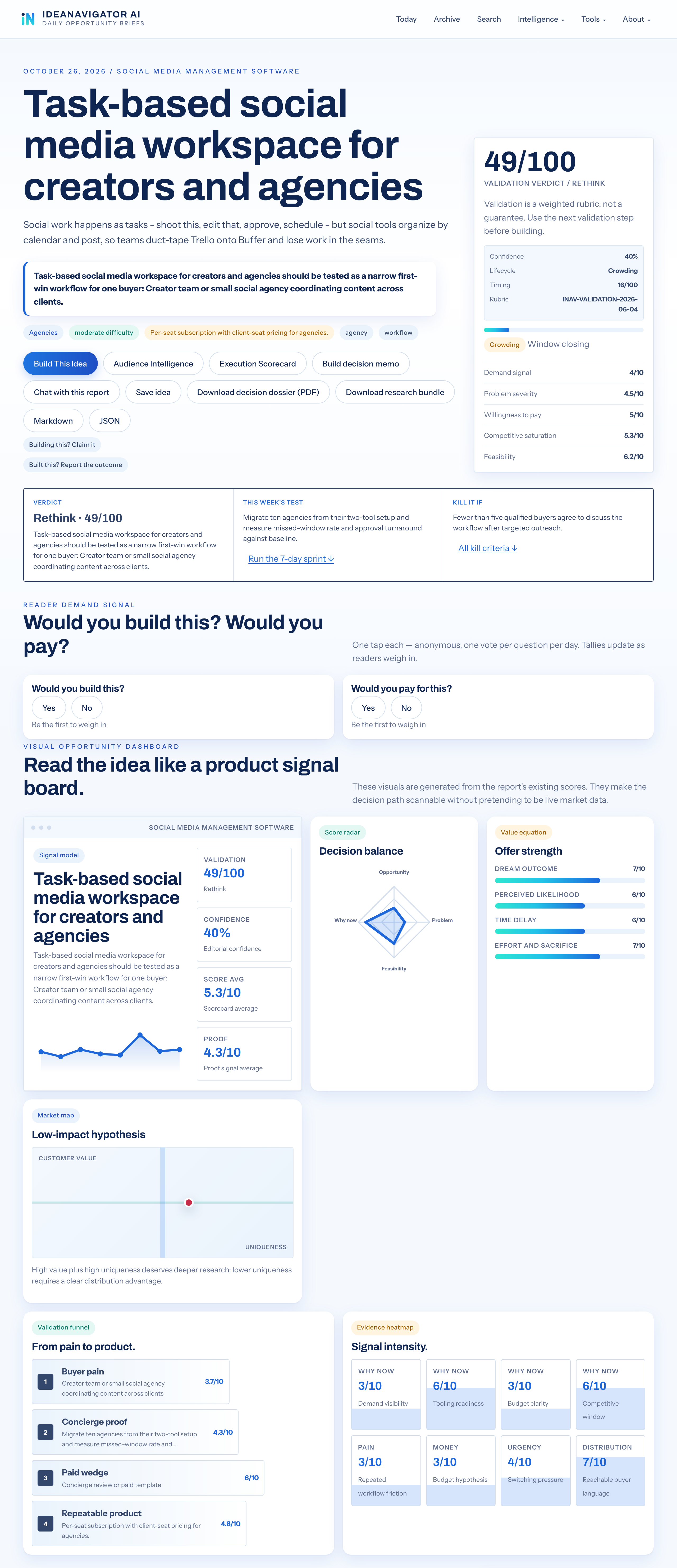
IdeaNavigator AI has outlined a proposed task-based social media workspace for creator teams and small agencies managing content across clients. The concept would connect post production, client approvals and scheduling, but it is a product opportunity to test—not a launched service or a proven improvement.
IdeaNavigator AI has proposed testing a social media workspace that treats each post as a task, connecting briefs, creative assets, editing, client approval and scheduling in one pipeline. The concept targets creator teams and small social agencies coordinating content for multiple clients; no product launch or validation results have been reported.
The proposed workspace would give each post a series of stages: brief, asset, edit, approval and scheduled. The goal is to keep the work needed to publish content attached to the post itself, rather than distributing tasks and files across separate project-management and social-scheduling tools.
IdeaNavigator AI also describes client-facing approval links, asset versioning and scheduling that begins after approval. Those functions are part of the suggested minimum viable product, not confirmed features of an available service. The proposal includes a per-seat subscription, with agency pricing that accounts for client seats, but gives no prices or commercial terms.
For validation, the proposal recommends moving ten agencies from their current two-tool arrangements and comparing missed publishing windows and approval turnaround with each agency’s baseline. No participating agencies, measurement period, baseline figures or test outcomes are supplied.
Connecting Post Work to Publishing
The idea addresses a workflow gap rather than simply adding another publishing calendar. Social content often requires multiple handoffs: someone briefs a post, another person makes or edits the asset, a client reviews it, and a team member schedules it. When those steps sit in different systems, teams may need to reconcile task status, file versions and publishing plans by hand.
A single post-linked workflow could make ownership and approval status easier to follow, particularly for small agencies handling several clients. Client-facing approval links could also reduce the need to manage feedback through disconnected messages, while versioning could help teams identify which asset is ready to publish. These are potential benefits described by the product concept, not outcomes established by evidence.
The proposed test focuses on two practical measures: missed-window rate and approval turnaround. Those measures would help determine whether combining work-management and scheduling functions makes a measurable difference for agencies. Without results from the suggested trial, it is not possible to say whether a dedicated workspace would outperform a team’s existing tools or justify another subscription.
Popular right now

Ninja Air Fryer XL, 6.5 Qt, 6-in-1, MaxCrisp, Dark Grey (AF181)

Vitamix 5200 Blender with 64 oz Container, Black

Dyson V8 Cordless Vacuum
As an affiliate, we earn on qualifying purchases.
The Proposed Two-Tool Problem
The proposal’s starting point is that social media platforms and scheduling products typically organize work around calendars and posts, while teams also need to manage the tasks that produce each post. IdeaNavigator AI says some teams bridge that gap by combining a social scheduler with a general-purpose project tool, creating seams where work can be lost.
That description is the proposal’s account of the opportunity, not independently measured evidence about how widely agencies use this setup. The material provides no survey, market-size estimate or comparison of existing products. Its stated market is social media management software, but the suggested first customer group is narrower: creator teams and small agencies coordinating content across clients.
The recommended approach is to test the workflow with a defined group before treating the idea as a broader product opportunity. Migrating ten agencies from two tools would let a team compare the new process with the agencies’ own prior performance, provided the baseline and measurement methods are recorded consistently.
Product and Trial Details Remain Open
No product launch, working prototype or trial results are described. The proposal does not identify a developer, participating agencies, a start date or a timetable for testing. It also gives no evidence that potential customers have agreed to pay for the service.
Several implementation details remain unspecified, including which social platforms would be supported, how scheduling would work, how client access and permissions would be handled, and whether existing tools could be connected. The proposal names asset versioning and approval links as desired features but does not explain their technical design.
The suggested outcome measures also need definitions before results could be compared. The proposal does not state what counts as a missed publishing window, how approval turnaround would be timed, or how many posts and clients each agency would include. Until a trial supplies those details and data, the expected workflow gains remain untested.
A Ten-Agency Test Is Proposed
The next step outlined by IdeaNavigator AI is to recruit ten agencies, document how they currently use two tools, and move their work into the proposed task-based process. A useful comparison would record baseline performance and apply the same definitions and time periods after migration, including any changes in missed publishing windows and approval turnaround.
No schedule or recruitment plan has been announced, and it is not clear whether the workspace has been built. Any later report would need to show the trial’s duration, participating teams, measurement rules and results before readers could judge whether the approach improved delivery or client review. For now, the development is a product concept with a proposed test, rather than evidence of a new service or proven business outcome.
Source: IdeaNavigator AI
Key Questions
Has the task-based social media workspace launched?
No launch is reported. The available details describe a proposed product and minimum viable feature set, not an available service.
Who is the proposed workspace for?
The initial target is creator teams and small social agencies coordinating content across clients.
What would the workspace include?
The proposed workflow would track each post through briefing, asset creation, editing, approval and scheduling. Suggested features include client approval links, asset versioning and scheduling after approval.
How would the idea be tested?
The proposal recommends moving ten agencies from their existing two-tool setups and measuring missed publishing windows and approval turnaround against baseline figures. No test results are available.
How might the service charge customers?
The proposed model is a per-seat subscription, with pricing for agency client seats. No actual price or confirmed commercial plan is provided.
Source: IdeaNavigator AI