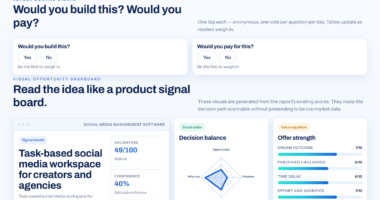
📊 Full opportunity report: How To Track AI Citations When Organic Traffic Changes on IdeaNavigator AI — validation score, market gap, and execution plan.

Get business pricing on office and shipping supplies
- Business-only prices and quantity discounts
- Tax-exempt purchasing
- Multiple users, one account, clear invoices
TL;DR

IdeaNavigator AI proposes a weekly citation-gap report for B2B brands that have lost organic referrals to AI assistants. The concept is a proposed product workflow, not a launched tool or a proven way to recover traffic; its suggested test is paid pilots with 10 brands over eight weeks.
IdeaNavigator AI has proposed a citation-tracking service for B2B brands that believe AI assistants are taking referrals from organic search. The proposed tool would monitor citations for 50 buying queries each week and identify competitor pages cited instead of a brand’s own content, but the concept has not been shown to recover traffic or improve citation counts.
The suggested product would run a brand’s top 50 buying queries through major AI engines, collect the URLs those systems cite, and compare competitor citations with the brand’s pages. It would then rank possible content rewrites by estimated traffic recovered. That estimate is a proposed prioritization measure, not a reported result.
IdeaNavigator AI identifies heads of content and SEO at B2B companies as the intended users, particularly teams seeing fewer organic referrals and lacking a way to identify which pages are cited in AI-generated answers. The proposed business model is a monthly subscription for each brand domain, with a separate agency tier for reporting across multiple clients.
For validation, the proposal recommends manually preparing citation-gap reports for 10 brands in one vertical, charging for the pilot, and tracking whether cited-page counts change within eight weeks of content rewrites. No participating brands, pilot findings, pricing, or product launch date are provided.
Track AI citations as referrals shift
IdeaNavigator AI proposes a weekly citation-gap report for B2B brands. It is a product concept to test, not a proven way to recover traffic.
How the proposed report works
It links a defined query set to cited URLs and possible content revisions.
Run the brand’s top 50 queries through major AI engines each week.
Collect cited URLs and flag competitor pages where the brand’s content is absent.
Rank possible rewrites by estimated traffic recovered, a proposed measure rather than a proven result.
What citation tracking can show
A repeatable record may help SEO and content teams decide which pages to review.
- Which URLs appear for monitored queries
- Where competitors are cited instead
- Whether cited-page counts change after edits
- Whether users click cited links
- Whether rewrites caused citation changes
- Whether organic referrals recover
Evidence the pilot needs
The proposal recommends paid, manually prepared reports for brands in one vertical.
Define the checks
Name the AI engines, queries, collection method, and repeated-check schedule.
Separate outcomes
Track citation counts and referral traffic separately, with a clear comparison method.
A Measurement Gap for SEO Teams
The proposal addresses a practical reporting problem: teams may see changes in search referrals without knowing whether AI-generated answers are citing their pages, competitors’ pages, or neither. A repeatable record of cited URLs could help content teams connect specific queries to pages that might need review, instead of relying only on broad traffic totals.
However, citation visibility and referral traffic are different measures. A page being cited does not establish that users clicked through, that a rewrite caused a citation change, or that any resulting traffic was incremental. The proposed report could give teams another signal to track, but claims about traffic recovered would require separate measurement and should not be treated as a guaranteed outcome.
Popular right now

KitchenAid Artisan Mini Tilt-Head Stand Mixer, 3.5 Qt, Contour Silver

Apple AirPods Pro (1st Generation) with MagSafe Charging Case

Ninja Foodi Air Fryer 8 Qt DualZone 6-in-1 Grey DZ201
As an affiliate, we earn on qualifying purchases.
From Search Referrals to AI Citations
The product idea is framed around a shift in how people find information: AI assistants and AI Overviews can provide answers to commercial queries and cite web pages, while conventional search referrals remain a concern for marketing teams. IdeaNavigator AI says teams are being asked to produce an AI-visibility plan without dedicated tooling. The material does not provide traffic data, a study, or a quantified estimate of how much search activity these systems intercept.
The proposed workflow narrows the broad question of AI visibility to a weekly comparison of citations for a defined query set. It would record which URLs appear, compare them with a brand’s own pages, and use the gaps to suggest content revisions. The plan is an MVP concept, not evidence that existing AI systems expose complete or stable citation data across engines.
Evidence Still Needed From Pilots
The proposal does not name the AI engines to be monitored or explain how it would handle answers that vary between users, sessions, or dates. It also does not specify how citations would be collected, how often results would be checked, or whether each engine provides access to data suitable for consistent tracking.
Most importantly, there is no reported evidence that rewriting pages based on citation gaps increases citations or restores organic referrals. The suggested eight-week test would need to distinguish changes associated with the rewrites from other changes, such as shifts in query demand, search rankings, or AI-answer behavior. Pricing, customer interest, and pilot outcomes remain unreported.
Paid Tests Would Set the Benchmark
The next step outlined by IdeaNavigator AI is a paid, manually produced pilot for 10 brands in a single industry. A useful report of that test would state which engines and queries were monitored, how citation counts were defined, what changes the brands made, and whether results held across repeated checks.
Any claim that the approach recovers traffic would also need referral data alongside citation counts, with a clear time window and comparison method. Until those results are available, the tracker is best understood as a product proposal to test, rather than a validated SEO solution.
Source: IdeaNavigator AI
Key Questions
What would the proposed AI citation tracker do?
It would check a brand’s 50 buying queries each week across major AI engines, collect cited URLs, compare competitor citations with the brand’s pages, and rank possible content revisions.
Is the tracker already available?
The available description outlines an MVP proposal and validation plan. It does not confirm a product launch, availability, or pricing.
Does getting cited by an AI assistant recover organic traffic?
Not necessarily. A citation count does not show whether users clicked a link or whether a rewrite caused more referrals. The proposed pilot would need to measure traffic separately.
How does IdeaNavigator AI suggest testing the idea?
It proposes paid, manually prepared citation-gap reports for 10 brands in one vertical, followed by measurement of cited-page counts within eight weeks of rewrites. No results from such a test are provided.
Source: IdeaNavigator AI