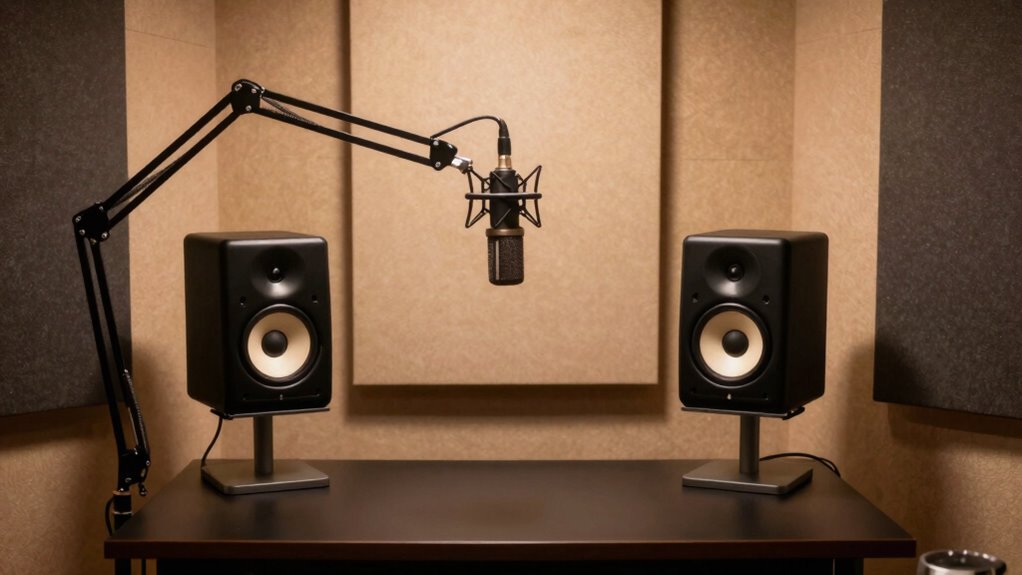

In small rooms, bigger studio monitors can cause more problems than they solve. They tend to reflect sound waves, creating echoes and standing waves that muddy your mix. Overly large speakers also amplify bass issues, leading to a distorted sound experience. Instead, focus on properly positioning smaller monitors and treating your room acoustically. With the right setup, you’ll achieve clearer, more accurate sound. Want to learn how to optimize your space? Keep exploring for expert tips.

Get business pricing on office and shipping supplies
- Business-only prices and quantity discounts
- Tax-exempt purchasing
- Multiple users, one account, clear invoices
Key Takeaways
- Larger monitors can cause excessive low-frequency buildup in small rooms, leading to muddiness.
- Smaller monitors with proper acoustic treatment often provide clearer, more accurate sound in limited spaces.
- Proper placement and acoustic treatments are more critical than monitor size for accurate monitoring.
- Smaller monitors reduce the risk of boundary interference and bass issues common in tight spaces.
- Critical listening and room adjustments are more effective than simply choosing bigger monitors.

Setting up studio monitors in small rooms can be challenging, but with the right approach, you can achieve accurate sound without sacrificing space. The key lies in understanding room acoustics and monitor placement. Small rooms tend to have reflections, standing waves, and other acoustic issues that can distort your sound. To counteract this, you need to pay close attention to how your room responds to sound, making adjustments to improve clarity and balance.
Begin by considering how room acoustics influence your listening environment. Hard surfaces like drywall, glass, or hardwood floors reflect sound waves, creating echoes and muddiness. To mitigate this, incorporate acoustic treatments such as bass traps, diffusers, and absorptive panels. These help control reflections, reduce flutter echoes, and improve sound clarity. Remember, you’re not trying to deaden the room completely but rather tame problematic frequencies and reflections that interfere with accurate monitoring. Proper acoustic treatment can significantly enhance your listening environment and monitoring accuracy.
Use acoustic treatments like bass traps and panels to tame reflections and improve sound clarity in small rooms.
Once you’ve addressed room acoustics, focus on monitor placement. Placing your monitors correctly is crucial for a balanced stereo image and accurate sound reproduction. Position your monitors at ear level, forming an equilateral triangle with your listening position. Keep them away from walls and corners—placing them too close can cause bass buildup and exaggerated low frequencies. Ideally, leave a few inches of space behind and to the sides of the monitors to reduce boundary interference and reflections. Use monitor stands or isolation pads to decouple the speakers from surfaces, which minimizes vibrations and prevents coloration of the sound.
In small rooms, it’s tempting to push monitors close to walls to save space, but this often results in bass honking and frequency masking. Instead, experiment with monitor placement, listening carefully to how changes affect the stereo image and frequency response. If you notice muddiness or uneven bass, try adjusting the distance from walls or changing the angle of your monitors slightly inward. Small adjustments can make a noticeable difference in the accuracy of your sound. Additionally, understanding room acoustics can help you better anticipate and address these issues for improved monitoring. Regularly testing your setup with different audio sources can reveal how your room influences sound and guide further refinements.
Finally, trust your ears. No amount of technical specifications can replace critical listening in your actual environment. Regularly check your mix on different systems to ensure your monitor setup accurately reflects the sound. With attention to room acoustics and careful monitor placement, you can transform a small space into an effective and precise recording environment. Bigger isn’t always better—smart placement and acoustic treatment will give you the clarity you need without crowding your room.
studio monitor acoustic treatment panels
As an affiliate, we earn on qualifying purchases.
As an affiliate, we earn on qualifying purchases.
Frequently Asked Questions
How Do I Choose the Right Size Monitor for My Small Room?
You should choose a monitor size that matches your room’s dimensions, focusing on monitor height and power handling. Smaller monitors, around 5-7 inches, work well in small rooms because they don’t overwhelm the space or cause acoustic issues. Confirm the monitor’s power handling capacity suits your setup to avoid distortion. Test different sizes if possible, and prioritize balanced sound and clarity over sheer size for the best results.
What Room Treatments Improve Monitor Performance in Small Spaces?
You can improve monitor performance in your small room by installing bass traps in corners to absorb low-frequency buildup and diffusion panels on walls to scatter sound waves. Bass traps reduce muddiness, while diffusion panels prevent sound reflections, creating a clearer, more accurate listening environment. Combining these treatments helps you hear your monitors more precisely, giving you better control over your mixes and a more balanced sound in tight spaces.
Can Placement Affect Sound Quality More Than Monitor Size?
A wise saying is, “It’s not the size of the dog in the fight, but the size of the fight in the dog.” Placement can indeed impact sound quality more than monitor size. Proper monitor calibration and speaker isolation are essential. Position your monitors at ear level, avoid reflective surfaces, and create a symmetrical setup to minimize sound issues. Good placement guarantees clear, accurate sound, making your smaller monitors perform surprisingly well.
Are There Specific Monitor Brands Better for Small Rooms?
Yes, certain monitor brands are better suited for small rooms. Look for brands with a strong reputation for quality and detailed sound, like Klipsch, Yamaha, or Adam Audio. These brands prioritize monitor aesthetics, ensuring the speakers fit well in tight spaces without compromising sound clarity. Pick monitors known for accurate reproduction and compact design, so you get the best sound experience without overwhelming your small room.
How Do I Prevent Acoustic Issues With Small Room Monitoring?
You can prevent acoustic issues by treating your room to improve bass response and reduce sound reflection. Did you know that even small changes, like adding bass traps or acoustic panels, can cut reflection echoes by 50%? Position your monitors away from walls and corners to minimize bass buildup and unwanted reflections. These steps create a clearer, more accurate sound environment, helping you produce better mixes without costly room renovations.
Conclusion
Remember, in the world of sound, size isn’t always king—like a whisper in a cathedral, clarity beats volume. In small rooms, choosing the right studio monitors is about finesse, not sheer scale. Think of it as tuning a finely crafted instrument; precision matters more than size. So, trust your ears, fine-tune your space, and let your music breathe freely—because sometimes, less truly is more, echoing the timeless wisdom of “less is more.”
Halloween Picks
halloween
As an affiliate, we earn on qualifying purchases.