
Among these smart doorbells, I rank the TP-Link Tapo D225 as the best overall for its 2K QHD video, included chime, and choice of wired or battery power. The Google Nest Doorbell (Wired, 3rd Gen) is a stronger fit for buyers who want a wired setup and 2K video, while the BOIFUN wireless model stands out for its no-subscription positioning and wide viewing angle. The main tradeoffs are whether you prefer battery convenience or dependable wired power, and whether you value local recording or a cloud-connected feature set. I compare all 11 options by installation, video coverage, storage approach, and likely household fit. Read on for the full breakdown and a buying guide to help narrow your choice.

Get business pricing on office and shipping supplies
- Business-only prices and quantity discounts
- Tax-exempt purchasing
- Multiple users, one account, clear invoices
Key Takeaways
- The Tapo D225 leads this group for all-around flexibility: 2K QHD video and an included chime make it a balanced choice, while its battery-or-wired setup can suit more entryways than a single-power design.
- Wired and battery models solve different problems: the Nest 3rd Gen is a wired pick for a fixed installation, while the Wyze, Tapo D210, Arlo, Ring, and BOIFUN options suit buyers who want battery power or a less permanent setup.
- No-subscription claims deserve a storage check: BOIFUN and Anona explicitly position themselves without subscriptions, but buyers should verify how clips are stored, accessed, and retained before choosing them over cloud-focused options.
- More cameras do not automatically mean better doorbell coverage: Anona’s dual-camera design and the Blink bundle address broader monitoring needs, but a buyer focused only on the front door may prefer a simpler single-camera unit.
- The two Nest listings are close, not separate feature categories: both identify the Wired 3rd Gen with 2K video; choose between Snow and Hazel based on the finish that fits the entryway, not an assumed performance difference.
| Wyze Battery Video Doorbell with Color Night Vision |  | Best for Flexible Power and Local Recording | Resolution: 1536 × 1536 | Field of view: 150° × 150° | Power: Battery powered or hardwired | VIEW ON AMAZON | See Our Full Breakdown |
| BOIFUN Wireless Video Doorbell Camera 2K HD with No Subscription, 166° Wide View, HDR Night Vision, Motion Alerts, Two-Way Audio, Battery Powered | 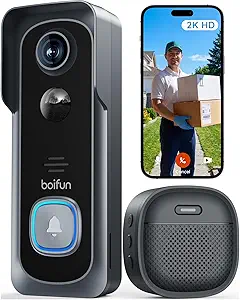 | Best for Subscription-Free Wireless Monitoring | Resolution: 2K HD | Field of view: 166° | Night vision: HDR night vision with 940 nm infrared | VIEW ON AMAZON | See Our Full Breakdown |
| Orbitell 1080p Wireless Video Doorbell Camera |  | Best for Basic Person Alerts | Model: M52 | Video resolution: 1080p | Connectivity: 2.4 GHz Wi-Fi; not compatible with 5 GHz | VIEW ON AMAZON | See Our Full Breakdown |
| Google Nest Doorbell (Wired, 3rd Gen) – 2K Video, Live View – Snow |  | Best Premium Wired Pick | Video capture resolution: 2K HDR | Field of view: 166° | Night vision: Color | VIEW ON AMAZON | See Our Full Breakdown |
| TP-Link Tapo D225 2K QHD Smart Video Doorbell with Chime |  | Best Overall for Wide Coverage | Resolution: 2K QHD | Field of view: 180° head-to-toe | Power options: 10,000 mAh battery or 8–24 V hardwired | VIEW ON AMAZON | See Our Full Breakdown |
| Blink Video Doorbell + Outdoor 4 Wireless Security Cameras System |  | Best for Whole-Home Coverage | Doorbell resolution: 1440 x 1440p | Outdoor 4 resolution: 1080p HD | Doorbell field of view: 150° | VIEW ON AMAZON | See Our Full Breakdown |
| Tapo D210 2K Wireless Smart Video Doorbell with Chime |  | Best for Local Recording | Resolution: 2K | Field of view: 160° diagonal | Power: 6400mAh rechargeable battery | VIEW ON AMAZON | See Our Full Breakdown |
| Arlo Video Doorbell 2K (2nd Gen), Wireless or Wired, 1 Camera |  | Best for Smart-Home Compatibility | Resolution: 2K | Field of view: 180° | Power options: Rechargeable battery or wired trickle charging | VIEW ON AMAZON | See Our Full Breakdown |
| Ring Battery Doorbell 2K – Retinal 2K Video, Wide-Angle, 6x Zoom, Two-Way Talk, Built-In Battery (Matte Mocha) |  | Best for Zooming In on Visitors | Video resolution: Retinal 2K; resolution may vary with bandwidth | Field of view: 140° horizontal, 140° vertical | Zoom: 6x enhanced zoom | VIEW ON AMAZON | See Our Full Breakdown |
| Google Nest Doorbell (Wired, 3rd Gen) with 2K HDR Video, Hazel |  | Best Wired Pick for Google Home | Video resolution: 2K HDR (2000) | Field of view: 166° | Power source: Corded electric | VIEW ON AMAZON | See Our Full Breakdown |
| Anona 3K Dual Camera Video Doorbell with No Subscription and Chime |  | Best for Subscription-Free Dual-Camera Coverage | Video resolution: 3K, 5MP | Camera configuration: Dual cameras: 5MP main and secondary | Night vision: Color | VIEW ON AMAZON | See Our Full Breakdown |
| smart doorbell | Field of view | Night vision | Audio | Connectivity |
|---|---|---|---|---|
| Wyze Battery Video Doorbell wi | 150° × 150° | Color | Two-way audio | — |
| BOIFUN Wireless Video Doorbell | 166° | HDR night vision with 940 nm infrared | Two-way audio | — |
| Orbitell 1080p Wireless Video | — | Infrared LEDs | Two-way audio | 2.4 GHz Wi-Fi; not compatible with 5 GHz |
| Google Nest Doorbell | 166° | Color | — | Wi-Fi |
| TP-Link Tapo D225 2K QHD Smart | 180° head-to-toe | Full-color with adjustable spotlight | — | — |
| Blink Video Doorbell + Outdoor | — | — | — | 2.4 GHz Wi-Fi, 802.11b/g/n |
| Tapo D210 2K Wireless Smart Vi | 160° diagonal | Full-color night vision with motion-activated spotlight | — | — |
| Arlo Video Doorbell 2K | 180° | — | Two-way audio | — |
| Ring Battery Doorbell 2K | 140° horizontal, 140° vertical | — | Two-way talk | 2.4 GHz single-band Wi-Fi 4 |
| Google Nest Doorbell | 166° | Color | Two-way audio | Wired, Wi-Fi |
| Anona 3K Dual Camera Video Doo | — | Color | — | 2.4GHz Wi-Fi; Wi-Fi 6 supported |
More Details on Our Top Picks
Wyze Battery Video Doorbell with Color Night Vision
The Wyze stands out for pairing battery or wired installation with a square 1536 × 1536 image that can show both a visitor and a package near the threshold. That head-to-toe framing is useful if deliveries are a regular concern, while color night vision and two-way audio add practical options after dark. Compared with the Tapo D225, Wyze has a narrower stated viewing angle and a lower maximum microSD capacity, but it offers a longer stated battery life than the BOIFUN’s laboratory estimate of up to 60 days. Local recording can avoid a required subscription, though the card is sold separately; 24/7 recording requires hardwiring. Chime accessories are also separate, so this is a stronger fit for shoppers who can supply their own storage and chime than for anyone wanting a complete, ready-to-go kit.
Pros:- 150° × 150° head-to-toe view helps include packages near the door.
- Battery or hardwired power accommodates different entryway setups.
- Color night vision and two-way audio support clearer nighttime interaction.
- Supports local microSD recording without a required subscription.
Cons:- MicroSD card and chime accessories are sold separately.
- 24/7 local recording requires hardwired power.
- The stated viewing angle is narrower than the Tapo D225’s 180° view.
Best for: Doorstep-focused households that want battery installation, optional hardwiring, and a path to local recording without a required subscription.
Not ideal for: Buyers who want a chime and memory card included, or who need continuous local recording without connecting doorbell wiring.
- Resolution:1536 × 1536
- Field of view:150° × 150°
- Power:Battery powered or hardwired
- Battery life:Up to 6 months
- Night vision:Color
- Audio:Two-way audio
- Storage:MicroSD up to 256 GB; card sold separately
- Compatibility:Alexa, Google Assistant, and IFTTT
Our verdict“Choose Wyze if you want flexible power and local storage options, and can provide the card and chime separately.”
BOIFUN Wireless Video Doorbell Camera 2K HD with No Subscription, 166° Wide View, HDR Night Vision, Motion Alerts, Two-Way Audio, Battery Powered
BOIFUN suits buyers who want a wireless 2K doorbell with local storage support and no subscription requirement for essential features. Its 166° view is wider than the Wyze’s stated 150° × 150° view, while HDR night vision uses 940 nm infrared for discreet nighttime monitoring rather than the Wyze’s color night vision. The built-in anti-theft alarm adds a layer of deterrence, but the headline battery estimate is up to 60 days under laboratory conditions, a much shorter stated interval than the Wyze’s up-to-six-month estimate or the Tapo D225’s up-to-eight-month estimate. It also works only on 2.4 GHz Wi-Fi, and the microSD card is not included. This is a sensible choice for shoppers prioritizing wireless setup and subscription-free basics, not for those seeking longer intervals between charging.
Pros:- 2K HD video and a 166° field of view cover a broad area.
- Essential features do not require a subscription.
- HDR infrared night vision supports discreet low-light monitoring.
- Built-in anti-theft alarm adds a deterrent.
Cons:- Supports 2.4 GHz Wi-Fi only, not 5 GHz.
- Up-to-60-day battery life is a laboratory estimate and varies with use.
- MicroSD card is sold separately.
Best for: Renters and homeowners seeking a wireless 2K doorbell with local microSD support and essential features that do not require a subscription.
Not ideal for: Households with only 5 GHz Wi-Fi or buyers who want a longer stated battery interval than the up-to-60-day laboratory estimate.
- Resolution:2K HD
- Field of view:166°
- Night vision:HDR night vision with 940 nm infrared
- Wi-Fi:2.4 GHz only
- Battery life:Up to 60 days under laboratory conditions
- Storage:MicroSD support up to 128 GB
- Audio:Two-way audio
- App:BoifunCam
Our verdict“Pick BOIFUN for wireless 2K monitoring and subscription-free essentials if 2.4 GHz Wi-Fi and more frequent charging suit your setup.”
Orbitell 1080p Wireless Video Doorbell Camera
Orbitell is the straightforward pick for buyers who value person-focused motion alerts over higher-resolution footage. Its AI detection can distinguish people from vehicles and animals, which may cut down on irrelevant notifications; the Tapo D225 also offers person detection, but adds package and vehicle alerts along with 2K video. Orbitell records at 1080p, so it gives up detail compared with the BOIFUN’s 2K HD and the wired Google Nest Doorbell’s 2K HDR. Its IP65 weather resistance and wireless installation suit exposed entries where running power is inconvenient. The tradeoff is that it uses 2.4 GHz Wi-Fi only, and pre-capture recording requires a cloud subscription. Buyers wanting local microSD recording or subscription-free pre-capture should look at the Wyze or Tapo D225 instead.
Pros:- AI detection identifies people and filters vehicles and animals.
- IP65 rating suits outdoor installation.
- Wireless setup avoids a hardwired power requirement.
- Two-way audio, motion alerts, and infrared night vision cover core monitoring needs.
Cons:- 1080p resolution provides less detail than the 2K BOIFUN and Google Nest options.
- Works with 2.4 GHz Wi-Fi only.
- Pre-capture recording requires a cloud subscription.
Best for: People who want a simple wireless doorbell with AI person detection and weather resistance for an exposed front entrance.
Not ideal for: Buyers who need 2K detail, 5 GHz Wi-Fi, or pre-capture footage without a cloud subscription.
- Model:M52
- Video resolution:1080p
- Connectivity:2.4 GHz Wi-Fi; not compatible with 5 GHz
- Audio:Two-way audio
- Night vision:Infrared LEDs
- Storage:Encrypted cloud storage
- Weather resistance:IP65
- Dimensions:1.77 × 1.34 × 5.4 inches
Our verdict“Choose Orbitell for basic person-focused alerts and wireless outdoor installation, but skip it if higher resolution or local pre-capture matters.”
Google Nest Doorbell (Wired, 3rd Gen) – 2K Video, Live View – Snow
The wired Google Nest Doorbell is the premium choice here for shoppers who want continuous power, 2K HDR video, and color night vision without managing a rechargeable battery. Its 166° view is wider than the Wyze’s stated 150° × 150° view, and its screw-in mount keeps the installation purpose-built for a wired doorbell setup. Gemini AI alerts and searchable video history can make reviewing activity more useful than scanning generic motion clips, but those advanced features require a Google Home Premium subscription. That makes the Nest less appealing to buyers seeking local storage without ongoing service costs; the Tapo D225 offers microSD support and battery installation, while Wyze also supports a battery option. Choose this Nest for a Google Home household with existing wiring, not for a rental or a setup centered on avoiding subscriptions.
Pros:- 2K HDR capture and a 166° field of view show a broad, detailed scene.
- Color night vision helps retain color detail in low light.
- Wired power avoids battery charging or replacement.
- Gemini alerts and searchable video history add useful event review tools with a subscription.
Cons:- Installation requires existing doorbell wiring and screw-in mounting.
- Advanced AI alerts and searchable history require Google Home Premium.
- Wired installation is less flexible than the battery-powered Wyze and Tapo D225.
Best for: Google Home households with existing doorbell wiring that want 2K HDR footage, color night vision, and searchable AI-assisted history.
Not ideal for: Renters, homes without compatible doorbell wiring, or buyers who want advanced AI features without a Google Home Premium subscription.
- Video capture resolution:2K HDR
- Field of view:166°
- Night vision:Color
- Power source:Corded electric
- Mount type:Screw-in doorbell mount
- Connectivity:Wi-Fi
- Compatibility:Google Assistant and Google Home
- Dimensions:5.16 × 1.65 × 1.14 inches
Our verdict“Choose the wired Nest if you have doorbell wiring and want Google’s 2K HDR and AI features, with the subscription requirement in mind.”
TP-Link Tapo D225 2K QHD Smart Video Doorbell with Chime
The Tapo D225 earns the most versatile spot in this group with a 180° head-to-toe view, 2K QHD video, and a choice of battery or hardwired power. That framing is broader than the Wyze’s 150° × 150° view and the BOIFUN’s 166° view, making the Tapo a stronger fit when a narrow entry or nearby packages are easy to miss. Its built-in rechargeable battery is rated for up to eight months, while hardwiring enables continuous recording. Person, package, and vehicle alerts are included, and microSD storage avoids a required subscription for local recording. The main limits are 2.4 GHz-only Wi-Fi and a separately purchased card. Compared with the wired Nest, Tapo is more flexible to install and store footage locally, though it does not offer the Nest’s stated 2K HDR or Gemini search features.
Pros:- 180° head-to-toe view helps capture visitors and deliveries near the threshold.
- Battery or 8–24 V hardwired power supports flexible installation.
- Person, package, and vehicle detection covers several common alert needs.
- MicroSD recording up to 512 GB is available without a required subscription.
Cons:- Supports 2.4 GHz Wi-Fi only, not 5 GHz.
- MicroSD card is not included.
- Full-color night vision uses an adjustable spotlight, which may not suit buyers seeking infrared-only monitoring.
Best for: Households wanting broad doorstep coverage, package alerts, local storage, and the choice between battery and wired installation.
Not ideal for: Buyers whose network relies on 5 GHz Wi-Fi or who expect a microSD card to be included.
- Resolution:2K QHD
- Field of view:180° head-to-toe
- Power options:10,000 mAh battery or 8–24 V hardwired
- Battery life:Up to 8 months
- Wi-Fi:2.4 GHz; does not support 5 GHz
- Local storage:MicroSD up to 512 GB; card not included
- Night vision:Full-color with adjustable spotlight
- Detection:Person, package, and vehicle
Our verdict“Choose the Tapo D225 for the broadest view and a strong mix of flexible power, detection, and local storage.”
Blink Video Doorbell + Outdoor 4 Wireless Security Cameras System
This bundle makes the most sense when a smart doorbell is only one part of the security setup. Alongside its 1440 x 1440p doorbell, four Outdoor 4 cameras can cover approaches and outbuildings, while the Blink app brings their feeds together. That broader coverage sets it apart from the Tapo D210, which focuses on the entrance but offers local microSD recording and a wider doorbell view. Blink’s stated battery life of up to two years can reduce routine battery changes, though actual life depends on use. The tradeoff is that cloud storage and advanced features require a subscription, and the bundle relies on 2.4 GHz Wi-Fi and a strong internet connection. Choose it for multiple-camera coverage; skip it if you only need a doorbell or want subscription-free recording.
Pros:- Includes a doorbell and four Outdoor 4 cameras for coverage beyond the front entrance.
- Doorbell records at 1440 x 1440p and includes infrared night vision.
- Two-way audio lets residents speak to visitors through the app.
- Specified battery life is up to two years, reducing frequent battery changes.
Cons:- Cloud storage and advanced features require a subscription.
- The cameras and doorbell need dependable 2.4 GHz Wi-Fi and internet access.
- Battery replacement is still part of long-term ownership.
Best for: Homeowners who want a battery-powered doorbell plus several cameras to monitor entrances and outdoor areas from one app.
Not ideal for: Shoppers who only need a front-door camera, prefer local recording, or cannot provide reliable Wi-Fi coverage around the property.
- Doorbell resolution:1440 x 1440p
- Outdoor 4 resolution:1080p HD
- Doorbell field of view:150°
- Power:Doorbell: 3 AA 1.5V lithium batteries; Outdoor 4: 2 AA 1.5V lithium batteries
- Stated battery life:Up to two years
- Connectivity:2.4 GHz Wi-Fi, 802.11b/g/n
- Doorbell dimensions:1.85 x 5.12 x 1.44 inches
Our verdict“Choose this bundle if you want a battery-powered doorbell that forms part of a wider multi-camera system, rather than a standalone entry camera.”
Tapo D210 2K Wireless Smart Video Doorbell with Chime
The Tapo D210 is a strong fit for buyers who want detailed doorbell footage without making cloud storage the only recording route. Its 2K video, 160° view, and person detection help show more of the doorstep and filter some activity; a microSD card supports local recording, though it is sold separately. Compared with the Arlo Video Doorbell 2K, which offers a 180° view and broad smart-home compatibility, Tapo gives local storage a more prominent role and includes an angled wedge for installation. The rechargeable battery allows placement without existing doorbell wiring, but battery life changes with activity and conditions. Cloud video history still needs a subscription, and the spotlight that enables color night vision may not suit every entrance.
Pros:- 2K video and a 160° diagonal view cover a broad area around the doorway.
- Person detection and activity zones help focus alerts on relevant movement.
- Supports local recording to a microSD card up to 512GB.
- Rechargeable battery and included 15° horizontal wedge offer flexible installation.
Cons:- A microSD card must be purchased separately for local recording.
- Cloud video history requires a Tapo Care subscription.
- Battery life varies with usage and environmental conditions.
Best for: Renters and homeowners who want a wireless 2K doorbell with person alerts and the option to keep recordings on a microSD card.
Not ideal for: Buyers who want included local storage, fixed-power operation, or a camera with a wider viewing angle than 160°.
- Resolution:2K
- Field of view:160° diagonal
- Power:6400mAh rechargeable battery
- Local storage:microSD card up to 512GB; card sold separately
- Night vision:Full-color night vision with motion-activated spotlight
- Wireless connectivity:2.4 GHz Wi-Fi
- Smart-home compatibility:Alexa and Google Assistant
- Included accessory:15° horizontal angled wedge
Our verdict“Pick the D210 if local microSD recording and customizable alerts matter more to you than a wider view or included storage.”
Arlo Video Doorbell 2K (2nd Gen), Wireless or Wired, 1 Camera
Arlo stands out for buyers who want a high-resolution doorbell that can fit several smart-home setups. Its 2K video and 180° field of view provide a broad look at visitors and packages, while wired or rechargeable installation makes it more flexible than the wired-only Google Nest Doorbell (Wired, 3rd Gen). Arlo also lists compatibility with Alexa, Apple Home, Google Home, Samsung SmartThings, and IFTTT, a wider platform mix than the Tapo D210’s Alexa and Google Assistant support. Person, package, pet, and vehicle detection add useful alert options, but some features and 60-day video history require a paid plan. It also depends on 2.4 GHz Wi-Fi, so check network coverage at the entry before choosing it.
Pros:- 2K video and a 180° field of view provide broad coverage around the door.
- Can be installed wirelessly or connected to wiring for trickle charging.
- Listed compatibility includes Alexa, Apple Home, Google Home, Samsung SmartThings, and IFTTT.
- Detection options include people, packages, pets, and vehicles.
Cons:- Some features, including 60-day video history, require a paid plan.
- Requires a 2.4 GHz Wi-Fi connection.
- The included Arlo Secure trial lasts one month, after which subscription features may require payment.
Best for: Households using a mix of smart-home platforms who want a 2K doorbell with wired or battery-powered installation.
Not ideal for: Buyers who want long-term video history or advanced detection without a subscription, or who need 5 GHz Wi-Fi support.
- Resolution:2K
- Field of view:180°
- Power options:Rechargeable battery or wired trickle charging
- Weather resistance:IP65
- Wireless connectivity:2.4 GHz Wi-Fi
- Audio:Two-way audio
- Smart-home compatibility:Alexa, Apple Home, Google Home, Samsung SmartThings, and IFTTT
- Included subscription trial:One month of Arlo Secure
Our verdict“Choose Arlo if broad smart-home compatibility and a 180° view are priorities, and you are comfortable paying for some recording features.”
Ring Battery Doorbell 2K – Retinal 2K Video, Wide-Angle, 6x Zoom, Two-Way Talk, Built-In Battery (Matte Mocha)
Ring’s clearest distinction in this group is its 6x enhanced zoom, which gives buyers a way to inspect details in the 2K image from the app. Its head-to-toe view covers the doorway vertically, though the 140° horizontal field of view is narrower than the Arlo Video Doorbell 2K’s 180° view. A built-in rechargeable battery and USB-C charging suit homes without doorbell wiring, and the product data lists tool-free installation. Alexa integration is useful in an Alexa-centered home, but this is less flexible across platforms than Arlo, which also lists Apple Home, Google Home, SmartThings, and IFTTT. Ring Protect is needed for full AI features, so the zoom and live alerts may be the more relevant reasons to pick this model over subscription-dependent analysis.
Pros:- Retinal 2K video and 6x enhanced zoom help inspect details remotely.
- Head-to-toe view covers the area directly in front of the door.
- Built-in battery recharges through USB-C.
- Designed for tool-free installation and integrates with Alexa.
Cons:- Full AI features require a paid Ring Protect subscription.
- The 140° horizontal view is narrower than the Arlo Video Doorbell 2K’s 180° field of view.
- USB-C charging cable is not included, and some video-analysis features are unavailable in certain states.
Best for: Alexa households that want a battery-powered doorbell and the ability to zoom in on people or objects in the camera view.
Not ideal for: Buyers seeking broad smart-home platform support, a very wide horizontal view, or full AI features without a Ring Protect subscription.
- Video resolution:Retinal 2K; resolution may vary with bandwidth
- Field of view:140° horizontal, 140° vertical
- Zoom:6x enhanced zoom
- Power:Built-in lithium-ion battery; USB-C recharge
- Connectivity:2.4 GHz single-band Wi-Fi 4
- Audio:Two-way talk
- Dimensions:2.11 x 5.78 x 1.41 inches
- Operating temperature:-4°F to 120°F (-20°C to 48.5°C)
Our verdict“Choose Ring if zooming in on a battery-powered doorbell feed and Alexa integration matter more than broad platform support or subscription-free AI features.”
Google Nest Doorbell (Wired, 3rd Gen) with 2K HDR Video, Hazel
For a home with existing doorbell wiring and Google Home at its center, this Nest is the most straightforward fit in the group. Wired power removes battery recharging from the routine, while 2K HDR, color night vision, and a 166° view help keep visitors visible across changing light. That view is wider than the Ring Battery Doorbell 2K’s 140° horizontal field, although Ring is the more flexible choice if wiring is unavailable. The Nest’s intelligent alerts and Google Home integration suit households already using Google’s app and devices; Gemini features add another layer, but some require Google Home Premium. Unlike the battery-powered Tapo D210, this model cannot be placed freely without suitable wiring. Choose it for a permanent Google-centered setup, not for installation flexibility.
Pros:- 2K HDR video and color night vision help preserve useful detail in varied lighting.
- 166° field of view covers more of the entry than the Ring Battery Doorbell 2K’s 140° horizontal view.
- Wired power avoids battery charging or replacement.
- Integrates with Google Home and supports Gemini features.
Cons:- Requires doorbell wiring, limiting placement compared with battery-powered options such as the Tapo D210.
- Some Gemini features require a Google Home Premium subscription.
- Its Google-centered integration may be a less natural fit for households using other smart-home platforms.
Best for: Homeowners with compatible doorbell wiring who already use Google Home and want a fixed-power camera with color night vision.
Not ideal for: Renters or households without doorbell wiring, and buyers who want battery-powered placement or to avoid subscriptions for Gemini features.
- Video resolution:2K HDR (2000)
- Field of view:166°
- Power source:Corded electric
- Connectivity:Wired, Wi-Fi
- Night vision:Color
- Audio:Two-way audio
- Dimensions:5.16 x 1.65 x 1.14 inches
- Included components:Base plate and wedge, spacers, mounting hardware, security screw, hex key, wire connector, and chime connector
Our verdict“Pick the wired Nest if you have compatible wiring and want a permanent 2K doorbell built around Google Home.”
Anona 3K Dual Camera Video Doorbell with No Subscription and Chime
The Anona stands apart in this group with two 5MP cameras, pairing detailed front-door footage with a secondary view that can help monitor the area below the doorbell. Its AI detection for people, pets, and packages does not require a subscription, a practical advantage over buyers who want alerts without adding an ongoing service. Compared with the Arlo Video Doorbell 2K, Anona offers a second camera and local microSD storage, while Arlo is the simpler single-camera alternative. The Anona also supports battery or wired installation, so it can suit more entry setups. The tradeoffs are a potentially involved setup and a microSD card sold separately; its storage tops out at 512GB, which may constrain long-term recording for households with frequent activity.
Pros:- Dual 5MP cameras provide more complete entry coverage than the single-camera Arlo Video Doorbell 2K.
- AI alerts for people, pets, and packages are available without a subscription.
- Battery or wired installation gives more flexibility around existing doorbell wiring.
- Color night vision and IP65 weather resistance suit outdoor monitoring.
Cons:- A microSD card is required for local recording and is not included.
- Setup may be complex for buyers who want a quick, straightforward installation.
- Local storage is capped at 512GB, which may not suit extensive recording needs.
Best for: Households wanting detailed, dual-angle entry monitoring, subscription-free AI alerts, and the choice of battery or wired power.
Not ideal for: Buyers seeking the simplest setup or extensive recording without managing local storage; the microSD card is not included and capacity is limited to 512GB.
- Video resolution:3K, 5MP
- Camera configuration:Dual cameras: 5MP main and secondary
- Night vision:Color
- Battery:5200mAh rechargeable; up to 100 days
- Power options:Battery-powered or wired
- Local storage:MicroSD up to 512GB; card not included
- Connectivity:2.4GHz Wi-Fi; Wi-Fi 6 supported
- Weather resistance:IP65
- Voice assistants:Alexa and Google Assistant
Our verdict“Choose the Anona if you want subscription-free AI alerts and dual-camera coverage; skip it if you prefer a simpler setup or do not want to manage a separate microSD card.”

How We Picked
I ranked these smart doorbells around the decisions that change daily use: power and installation, useful video coverage, included chimes, storage and subscription expectations, and how well each design fits a particular home. I gave weight to clear distinctions buyers can act on, such as wired versus battery operation, stated resolution, wide or dual-camera views, and whether a product is bundled with additional cameras. A higher resolution or larger bundle does not automatically earn a higher place if it adds setup complexity or solves a need many doorbell shoppers do not have.
The Tapo D225 takes the top spot because its stated feature set balances video, chime, and power flexibility. Other picks rank for narrower needs: the Nest models for wired installation, the Blink package for multi-camera coverage, and BOIFUN or Anona for buyers drawn to no-subscription positioning. Where two listings share a model name and core specifications, I treat them as close alternatives rather than inventing a performance gap. Product-specific storage, compatibility, and feature availability can vary, so I recommend checking those details against the exact version before buying.
| smart doorbell | Night vision | Audio |
|---|---|---|
| Wyze Battery Video Doorbell wi | Color | Two-way audio |
| BOIFUN Wireless Video Doorbell | HDR night vision with 940 nm infrared | Two-way audio |
| Orbitell 1080p Wireless Video | Infrared LEDs | Two-way audio |
| Google Nest Doorbell | Color | — |
| TP-Link Tapo D225 2K QHD Smart | Full-color with adjustable spotlight | — |
| Blink Video Doorbell + Outdoor | — | — |
| Tapo D210 2K Wireless Smart Vi | Full-color night vision with motion-activated spotlight | — |
| Arlo Video Doorbell 2K | — | Two-way audio |
| Ring Battery Doorbell 2K | — | Two-way talk |
| Google Nest Doorbell | Color | Two-way audio |
| Anona 3K Dual Camera Video Doo | Color | — |
Factors to Consider When Choosing Smart Doorbells
Choosing a smart doorbell is less about chasing the biggest resolution number and more about matching the device to your wiring, entryway, and appetite for ongoing storage costs. I’d settle the practical constraints first, then compare features that improve the view or make alerts useful.
Choose Power Around Your Door, Not Just Convenience
A wired doorbell can avoid routine battery charging, but it depends on compatible existing wiring and may require more involved installation. Battery models offer more placement flexibility, though charging intervals depend on activity, settings, and conditions. A wireless model still needs a plan for charging and for keeping the device online. Before ordering, check your current doorbell wiring, chime setup, and the manufacturer’s compatibility details. Buyers often focus on installation day and overlook the maintenance routine that follows. If reaching the doorbell to recharge it would be awkward, a wired option such as the Nest may suit better; if your wiring is absent or uncertain, consider a battery model with a clear return path if compatibility falls short.
Match the Camera View to the Shape of Your Entryway
Resolution helps, but the camera’s angle and mounting height determine whether you can see a visitor, a package, or the steps below the door. A wide view can cover more of a narrow porch, while a dual-camera layout may show a different portion of the approach. Look for the field-of-view details and any aspect-ratio information the maker provides, rather than treating “2K” as a guarantee of useful coverage. A camera mounted too high or too far to one side can still miss deliveries. Consider where visitors stand and where packages are usually left before deciding which view you need. If package visibility matters most, prioritize downward coverage; if the space is compact, a wide-angle view may be sufficient.
Understand What “No Subscription” Means for Your Clips
A no-subscription label can be attractive, but it does not explain where recordings live or how long they remain available. Check whether storage is local, what hardware is needed, whether remote access works without a plan, and how clips can be exported. Cloud services may simplify access and provide features that local storage does not, but they can bring recurring charges or plan limits. Local recording can reduce dependence on a subscription while placing more responsibility on the owner to manage storage and device access. Do not assume that live view, alerts, and saved footage all follow the same rules. Compare the storage terms for the exact model and region before treating a doorbell as subscription-free in practice.
Check Chime and Household Compatibility Before You Buy
An included chime can make a doorbell easier to hear indoors, but it is not the same as confirming compatibility with an existing mechanical or digital chime. If household members do not keep a phone nearby, audible alerts may matter as much as camera quality. Check whether the chime connects by plug-in power, uses a separate accessory, or relies on an existing doorbell circuit. Also confirm that the app and smart-home integrations work with the phones and devices your household already uses. A common mistake is buying a camera first and discovering that the alert experience does not fit the home. Treat the chime, app access, and household notification needs as part of the product—not as afterthoughts.
Decide Whether You Need One Doorbell or a Wider Camera System
A doorbell camera is a focused way to monitor the entrance, while a bundle such as the Blink system extends coverage to other areas. Extra cameras make more sense when you already have specific blind spots to cover, such as a side path or garage approach. They can also add setup tasks, power planning, app management, and more devices to maintain. For a front-door-only need, a bundled system may be more equipment than the job requires. Map the areas you want to monitor before comparing packages, and avoid paying attention to camera count alone. A multi-camera system is a better fit when broader property coverage is a genuine goal, not simply because the bundle looks more complete.
Treat Resolution as One Part of Nighttime and Alert Performance
Higher stated resolution can retain more detail, but it cannot compensate for poor placement, an obstructed view, or lighting that overwhelms the camera. Night vision, HDR, and color-night features aim to help under different lighting conditions, so match the listed capability to the light around your entrance. A porch light, reflective siding, or a streetlamp can change how the camera handles night scenes. Motion alerts also need to be useful rather than constant; think about passing foot traffic, pets, and nearby roads. Review the available settings for alert zones and sensitivity, then check whether key functions depend on an app plan. This approach helps avoid choosing by video resolution alone when the real need is reliable, relevant alerts after dark.
Frequently Asked Questions
Should I choose the Tapo D225 or the Tapo D210?
I’d start by comparing the exact power and feature requirements of the two listings, not their shared Tapo name. The D225 is the stronger all-around pick in this roundup because its stated 2K QHD video, included chime, and flexible power options make it adaptable to more setups. The D210 is also a 2K wireless model with a chime, so it may be the more straightforward match if you specifically want a battery-powered unit. Check each listing for included accessories, wiring compatibility, storage terms, and app features. If your installation needs flexibility, lean toward the D225; if you want a simpler wireless setup, compare the D210’s exact package details.
Are the two Google Nest Doorbell Wired 3rd Gen listings different?
Both listings describe the Wired 3rd Gen with 2K video, while one specifies Snow and the other Hazel. The information provided does not establish a difference in core performance between those versions. I would choose based on the finish that best suits the doorframe and on confirming that the listing matches the product generation you want. Before buying, check the wiring and chime requirements, since both are wired models. If you need battery operation, neither finish changes that limitation; consider a battery-capable option instead.
Can I use a battery doorbell if my home has no existing doorbell wiring?
Battery-powered models are generally the more practical category to investigate when wiring is absent, but check each device’s installation instructions and included accessories. The Wyze, BOIFUN, Tapo D210, Arlo, and Ring listings identify battery power or wireless operation, while the Nest listings are explicitly wired. Wireless does not mean maintenance-free: you will need to recharge or replace the battery, and placement must still allow a reliable connection. Confirm whether the model can also be wired if you later change your setup. If an included indoor chime matters, verify that it is part of the package rather than an optional add-on.
Does a no-subscription smart doorbell still save video?
It can, but “no subscription” alone does not tell you how recording works. Check whether the model uses local storage, whether a separate card or hub is required, how long clips remain available, and whether you can view them remotely. The BOIFUN and Anona listings explicitly promote no-subscription use, but their exact storage details should guide the decision. A cloud plan may offer a simpler path to saved clips, while local storage can limit recurring service dependence. If recorded evidence matters to you, confirm clip retention and export options before choosing based on the subscription claim alone.
When does a doorbell-and-camera bundle make more sense than one doorbell?
A bundle is useful when you can name additional areas that need coverage, such as a side entrance or a path approaching the house. The Blink package includes four outdoor wireless cameras alongside its video doorbell, so it targets broader monitoring rather than only the front step. That wider setup also means more devices to place, power, connect, and manage. If the front door is your only concern, a single doorbell is likely simpler to install and maintain. Draw a quick coverage map first; choose a bundle only when its extra cameras solve real blind spots.
Conclusion
For most shoppers, I’d choose the TP-Link Tapo D225 as the best overall because its 2K QHD video, chime, and flexible power options make it the most adaptable pick in this group. The BOIFUN is my best value-oriented choice for buyers who want wireless operation, a wide view, and no-subscription positioning, provided its storage details meet their needs. For a best premium, wired-focused option, I’d look at the Google Nest Doorbell Wired 3rd Gen; the two color listings appear to share the same core product, so choose the finish that suits your entryway. Beginners may prefer a model with a clearly included chime and a setup that matches existing power, rather than starting with a multi-camera system. Choose Blink for broader outdoor coverage, Anona if its dual-camera view and storage terms fit your priorities, and a battery-capable Arlo, Ring, Wyze, or Tapo model when wiring limits placement. My final check would be power compatibility and saved-video terms: those details matter more to long-term satisfaction than a resolution label alone.
Halloween Picks
halloween
As an affiliate, we earn on qualifying purchases.